Gluten-Free Label Meaning: FDA Rules and Package Checks
For US FDA-regulated food, a gluten-free claim means the food must meet ingredient conditions and contain less than 20 ppm gluten. Read the current package: the number, ingredient list, wheat-allergy information and any certification mark answer different questions.
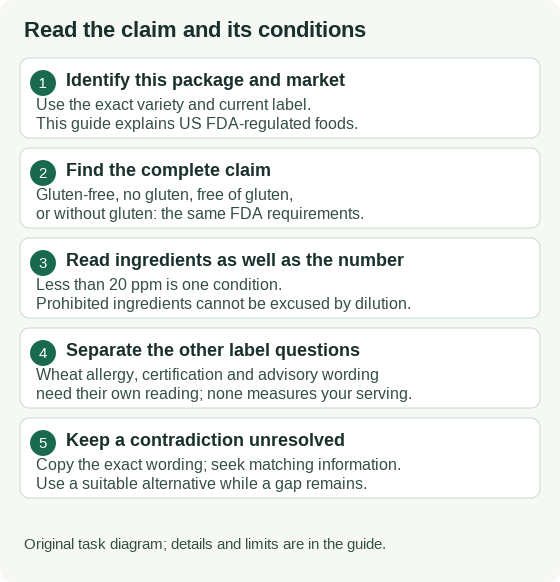
What gluten-free means on an FDA-regulated food
For a US food under FDA labelling authority, gluten-free means the food must meet the FDA ingredient conditions and contain less than 20 parts per million of gluten. The words are a regulated voluntary claim, not a promise of absolute zero gluten. A manufacturer does not have to use the claim on every food that could qualify.
FDA treats “gluten-free,” “no gluten,” “free of gluten” and “without gluten” as equivalent claims under this rule. You can find the words on the front, side or back: FDA does not prescribe a particular position. Read the actual package rather than judging the claim from a shelf sign, a cropped retailer photograph or the product name.
This guide covers FDA-regulated food sold in the United States, including imported food within that authority. Some meat, poultry and egg products fall under USDA labelling, and many alcoholic drinks have TTB oversight. For another market, use the US, UK, EU and Australia label comparison rather than treating this US explanation as a worldwide definition.
Why the 20 ppm number is not the whole rule
The ingredient restriction matters before anyone argues about a small serving or a low test result. A food bearing the claim cannot intentionally include a gluten-containing grain such as ordinary wheat, barley or rye, or an ingredient derived from one that has not been processed to remove gluten. The rule also covers their crossbred hybrids.
A specifically processed grain-derived ingredient is a different case. It must have been processed to remove gluten, and its use cannot result in 20 ppm or more gluten in the food. Any unavoidable gluten present must also remain below 20 ppm. This is why “wheat” in a label needs its actual context, while ordinary wheat flour is not made compliant simply by using less of it.
FDA expressly says barley malt, malt extract and malt syrup cannot be used in foods bearing a gluten-free claim. “It is only a minor ingredient” or “the finished test was low” does not answer that restriction. If a current US package appears to combine barley malt with a gluten-free claim, copy both statements and resolve the inconsistency for that exact product. Do not invent an acceptable portion to reconcile them.
For the similarly named ingredient maltodextrin, use the barley malt versus maltodextrin guide. Searching for the letters “malt” is a way to notice a word; it cannot identify the ingredient by itself.
| What you read | What it supports | What remains to check |
|---|---|---|
| A gluten-free claim on an FDA-regulated package | The food is represented as meeting the rule. | The current product, full label and any apparent contradiction. |
| A claimed result below 20 ppm | One reported concentration result. | Ingredient conditions, applicable method and the rest of compliance; the number alone is incomplete. |
| Ordinary barley malt in the ingredients | A named gluten-containing derivative addressed by FDA. | Do not dismiss it because the quantity is small or the wheat allergen line is absent. |
| Specially processed wheat starch with a gluten-free claim | A possible specific processed-ingredient situation. | Read the full explanation and allergen information; gluten-free does not mean wheat-free. |
Read the package in a useful order
- Match the item. Confirm the exact product, flavour and country of sale. Similar bottles from one brand can use different ingredients.
- Find the actual claim. Read every panel. Record its complete words, and keep a third-party certification symbol as a separate observation.
- Read the whole ingredient list. Notice wheat, barley, rye and relevant derivatives. Do not replace that list with only an allergen line or a list of familiar “safe” brand names.
- Read allergen and advisory information for their own purposes. Keep the exact wording rather than compressing everything into “GF.”
- Resolve the specific gap. If the claim, ingredients or product identity appear inconsistent, seek current information that matches this variety and market, or use a suitable alternative while the question remains open.
The job is to read and identify the product, not to run a laboratory test in the supermarket. FDA places responsibility for complying with the claim on the manufacturer. It does not impose a blanket requirement that every manufacturer test every batch as a condition of using those words.
If the label is familiar but has changed, the packaging-change recheck has an old/new worksheet and a focused manufacturer question. That is a different task from interpreting what the claim means.
Why wheat-free and the allergen line are different
Wheat-free does not mean gluten-free. Barley and rye also contain gluten, so a wheat-related statement does not settle the broader question. The absence of a separate “contains wheat” line is not proof that the ingredient list has no gluten sources.
The reverse distinction matters too: a food can use a wheat-derived ingredient specifically processed to remove gluten and meet gluten-free requirements. FDA explains additional disclaimer requirements when such a food bears the claim and declares wheat. Do not assume that the claim makes it appropriate for a person with wheat allergy.
For example, the practical note “gluten-free claim present; specially processed wheat starch listed; separate wheat-allergy question” preserves three different facts. Rewriting that note as “contains no allergens” loses information. Gluten-free also does not answer whether soy, milk or another ingredient fits an individual allergy requirement.
If your decision depends on a diagnosed allergy, celiac disease or an individual dietary plan, use the advice that applies to that need. This guide explains label meanings; it does not determine a personal safe amount of gluten or assess symptoms.
Read advisory statements and certification separately
A statement such as “made in a facility that also processes wheat” is not the same statement as “contains wheat.” FDA permits truthful, non-misleading advisory wording alongside a gluten-free claim; the food bearing that claim must still meet the rule. Neither the presence nor absence of a facility statement lets you calculate the gluten concentration of the food.
Do not conclude that a facility advisory automatically cancels the claim, and do not conclude that a missing advisory proves there was no shared equipment. Copy the wording and seek product-specific clarification if it leaves a question relevant to your dietary needs.
Third-party certification is also separate. FDA does not endorse, accredit or recommend a particular gluten-free certification program. A plain compliant claim does not need a specific private logo under the FDA rule. A program may impose additional requirements, but you need the named program and exact product to understand them.
Use certified gluten-free versus a gluten-free claim to learn how to verify a mark. Do not describe an ordinary private symbol as “FDA-certified.”
What a missing claim does and does not mean
A missing gluten-free statement does not prove that every food contains gluten. FDA gives naturally gluten-free foods, including fresh fruits and vegetables, as examples that may not carry the voluntary claim. “Not labelled” and “contains gluten” are different observations.
For a processed food you intend to rely on, the same absence also does not confirm suitability. You may need current ingredient and manufacturing information. A brand-wide reply saying “we sell gluten-free products” does not identify whether this particular variety is one of them.
Likewise, “made with no gluten-containing ingredients” is an ingredient-related statement. FDA says consumers should not assume that all gluten-free-claim requirements are met unless the label also bears a gluten-free claim. Keep that difference visible instead of treating every reassuring phrase as equivalent.
An effective question identifies the exact product and asks about one missing fact: “For this variety sold in the US, the current package says [words] and lists [ingredient]. Does your current gluten-free information apply to this product, and how should this apparent inconsistency be read?” Keep an incomplete response incomplete.
The package does not describe every later handling step
The original package information does not establish what happened after opening. A spoon that returns from wheat bread to a spread, an earlier marinade in a restaurant dish or a shared fryer introduces a separate preparation question.
For a suitable sealed sauce, read the whole recipe before adding it. Replacing the final drizzle cannot remove a different wheat-containing sauce already mixed into the food. For household spreads, use the shared-condiment procedure; it covers protected stock and serving utensils.
For dining out, use the whole-order question card. A menu symbol helps start a conversation; it does not measure the plate or confirm all ingredients and preparation. If the issue is illness or suspected exposure, seek appropriate healthcare advice rather than testing an unclear food by taste or waiting for symptoms.
Keep the facts and the next question
Download the plain-text record, or copy the fields below. Leave missing information marked unknown.
US GLUTEN-FREE CLAIM READING RECORD
Exact product and variety:
Country of sale and applicable authority:
Current claim, copied in full:
Claim location on the package:
Full ingredient list read:
Relevant grain or processed-ingredient wording:
Allergen statement, copied separately:
Advisory statement, copied separately:
Certification issuer and mark, if any:
Specific contradiction or missing fact:
Current product-specific information and its limits:
Suitable alternative while unresolved:
Later handling or whole-recipe question:
A claim is not a zero-gluten guarantee or a personal safe dose.
Try these reading checks
These are original fictional situations for practising the distinctions in this guide.
A fictional US cereal lists barley malt and says its result is 12 ppm. Does that number alone justify a gluten-free claim?
No. FDA restricts barley malt in foods bearing the claim. A result below 20 ppm does not remove the ingredient condition. Keep the apparent inconsistency unresolved and obtain matching current information rather than inventing a permissible portion.
A result is exactly 20 ppm. Is that less than 20 ppm?
No. Exactly 20 is not below 20. This illustrates the boundary wording, not approval of a real food from a single measurement; ingredients and the other applicable conditions still matter.
A package has no separate wheat warning. Does that rule out barley or rye?
No. A wheat-only observation does not answer the broader gluten question. Read the whole ingredient list and the actual gluten-free information.
A US product has a gluten-free claim and a truthful wheat-facility advisory. Must the advisory automatically cancel the claim?
No. FDA allows the two statements together if truthful and not misleading, and the gluten-free claim still must comply. Read the actual product information and clarify any relevant uncertainty; do not infer a gluten measurement from the advisory.
Sources and scope
- FDA: Questions and Answers on Gluten-Free Food Labeling
- FDA: Gluten and Food Labeling
- Celiac Disease Foundation: Label Reading and the FDA
FDA supplies the US scope, voluntary claim, ingredient restrictions, less-than-20-ppm condition and distinctions about advisory wording, testing and certification. The Celiac Disease Foundation supports the full ingredient and wheat-only label checks. The linked guides handle packaging changes, certification and other countries separately. No product or batch was tested and no personal dietary clearance is given.
Sources checked 2026-11-03. A check date records when the listed information was read; it does not mean the source or rules changed on that date. The examples, diagram and record are original teaching material.