Gluten-Free Restaurant Question Card: Check the Whole Order
Ask about the complete dish before it is prepared: ingredients, earlier sauces, coatings, sides, shared preparation and serving. This card gives you exact questions and a way to keep unanswered details visible when choosing an alternative.
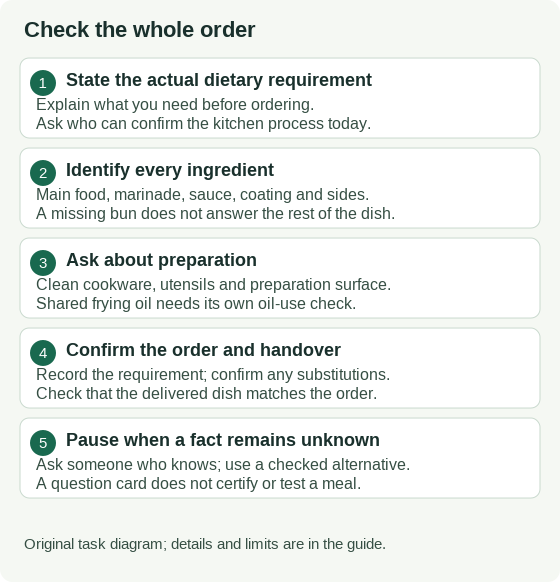
A short card you can show before ordering
Use this card before the food is prepared. Fill in the actual dish and requirement; if you have celiac disease or a separate allergy, explain that accurately. Do not claim a diagnosis you do not have or assume that the words “no bread” describe everything you need.
Whole-order gluten-free question card
My requirement: I need food that meets my gluten-free requirements, including ingredients and avoiding gluten cross-contact. [Add celiac disease or a separate allergy only where it actually applies.]
Dish I am considering: [exact dish and version]. Can someone who knows today’s kitchen preparation check the ingredients, including the marinade, sauce, coating, seasoning and every side or garnish?
Preparation: Can this order be prepared with appropriate clean cookware, utensils and a clean preparation area? If anything is fried, what else uses that oil?
Handover: Please record the gluten-free requirement and any agreed substitutions with the order. Can you confirm that the kitchen and the person serving it receive those instructions?
If a detail cannot be confirmed: Please tell me what remains unknown. I will choose another option whose ingredients and preparation can be checked, or arrange another meal.
This is an original conversation aid. It does not certify a meal, inspect a restaurant or measure gluten. The value is the specific answer it helps obtain, not the act of handing over a card.
Ask the useful questions before you are hungry
The Celiac Disease Foundation recommends researching a restaurant, looking at its menu and calling during a quieter period. Ask whether it has gluten-free options and whether staff understand the requirement. A menu can help you find a dish to discuss; it is not proof of how today’s kitchen will prepare it.
Name one or two actual choices when asking ahead. “Can you explain the ingredients and preparation for [dish] at this location?” is easier to answer than “Is your restaurant safe?” A clear earlier reply is still attached to that location, dish and time. Recheck relevant details when ordering, especially if the menu, supplier or staff answer has changed.
Arrange a suitable backup before the visit. Depending on the occasion, this might mean eating beforehand, bringing a checked snack where permitted or choosing another restaurant that can answer. A grilled dish, a salad or a packaged side still needs its own ingredients and preparation checked; “simpler” does not mean automatically suitable.
Map the components that a menu description leaves out
Begin with the whole plate. An unbreaded main ingredient does not identify a marinade, cooking sauce, stock, thickener, seasoning blend or garnish. A wheat-containing sauce can enter before cooking, so requesting a different final dipping sauce may be too late to change that ingredient.
The Celiac Disease Foundation’s dining guidance lists questions about flour dusting, soup ingredients, salad toppings, marinades and fried foods. Use the current recipe or product information for the dish rather than assuming a familiar name always uses the same ingredients.
| Component | Question to ask | What a broad reply misses |
|---|---|---|
| Main food | What is the exact product or recipe for this dish? | A menu name does not identify every ingredient. |
| Marinade and cooking sauce | Was it marinated or mixed with sauce before cooking? Can that recipe or bottle be checked? | “Sauce on the side” may describe only the final sauce. |
| Coating or flour dusting | Is there batter, breading or flour added before cooking? | “Not served with bread” says nothing about a coating. |
| Seasoning and stock | What goes into the seasoning blend, broth or stock? | Plain-looking rice, vegetables or meat may be seasoned. |
| Sides and garnish | Which sides, toppings, chips, crumbs or fried garnish will be included? | A checked main does not cover unexamined extras. |
| Substitution | What exact replacement will the kitchen use, and can its ingredients and preparation be confirmed? | A substitute has its own recipe; it is not approved by its name. |
Ask about the process as well as the ingredients
After the ingredients are identified, ask what the food touches during preparation. The Celiac Disease Foundation recommends questions about clean or separate preparation space, cookware, utensils and grills. Ask the kitchen to describe what it can actually arrange for this order.
“We have gluten-free ingredients” is an ingredient answer. It does not explain whether a shared pan, preparation surface or serving utensil will transfer residue. A description such as “we will use [identified clean pan and tools] in [described preparation area]” gives you a specific process to discuss rather than a vague reassurance.
For fried food, go to the six shared-fryer questions. That guide distinguishes the oil from the basket and covers food, coatings, sauces and transfer. A separate basket does not answer whether the same oil is used for gluten-containing breaded food.
For other processes, identify the task. Pasta has cooking water and draining tools; tacos have tortillas and serving utensils; stir-fried noodles have sauces, cookware and utensils. The cuisine guides below turn this general card into those particular questions. No one word such as “dedicated” replaces a description of the arrangement.
Turn an incomplete answer into one precise follow-up
| Staff reply | One useful follow-up | Why it matters |
|---|---|---|
| “There is no bread.” | Can you check the marinade, coating, sauce, seasoning and sides? | Bread is only one possible component. |
| “The sauce will be on the side.” | Was a sauce already used in the marinade or cooking? | Changing the final serving does not remove an earlier ingredient. |
| “It is on our gluten-free menu.” | How is this exact dish prepared and served today? | The symbol does not describe the current process. |
| “We use a separate basket.” | Is the oil also separate from gluten-containing breaded food? | Oil and basket are different contact questions. |
| “I think it should be fine.” | Who can check the current product and kitchen preparation? | A guess is not a confirmed ingredient or process. |
| “We cannot confirm that sauce.” | What alternative can you identify and prepare with its ingredients and handling checked? | The unresolved component needs a real next choice. |
You do not need to ask every question again after a clear answer. Focus on the missing fact. If the staff cannot identify an ingredient or preparation step, keep it unknown. Pressure from hunger, a busy table or a reassuring tone does not supply that information.
The sources support asking and being prepared to change your first choice. They do not show that a written card eliminates errors or that a particular restaurant has been independently tested.
Keep the agreed instructions with the order
Once a workable dish is identified, repeat the complete order: the exact main, sauce arrangement, sides, substitutions and preparation instructions. Ask that the actual gluten-free requirement be recorded and communicated to the kitchen. If another person takes over, keep the relevant instructions attached to the order.
For takeaway or delivery, the package label and order note help identify what was requested, but they are not proof of the contents. Where possible, confirm the dish and changes with the restaurant before relying on it. A third-party menu photograph or your typed note alone does not establish that the kitchen can meet the requirement.
Before eating, check that the delivered dish matches the agreed order. If bread, a breaded garnish, an unidentified sauce or a different side appears, pause and ask. Picking off the unexpected component does not establish whether it already contacted the food or whether the rest of the order was prepared as discussed.
Keep the difference between requesting and confirming visible in your record. “Asked for no wheat-containing sauce” describes a request. “Kitchen identified the exact sauce and confirmed the substitution before cooking” records an actual answer. Do not write the second when you only know the first.
Three examples of following the whole order
Grilled main with sauce: The server offers a gluten-free sauce at the table. Ask what marinade and cooking sauce were used earlier, and check the sides and preparation. A suitable finishing sauce cannot replace information about a different sauce already cooked into the dish.
Salad without croutons: Ask for the ingredients and preparation of the complete replacement order, including dressing and any crispy garnish. If croutons arrive, removing them is not a description of how the bowl was prepared or whether they touched the rest of the salad. Pause and ask for the order to be clarified.
Rice dish with fried extras: A checked rice base does not cover fried chips, battered protein or a sauce served with it. Identify each component. If shared oil is the blocker, use the separate fryer guide and choose an alternative only after its own ingredients and handling are identified.
These are invented teaching examples, not reports from specific restaurants. Each separates a component that has been checked from one still missing; none uses a cuisine name or lack of bread as whole-meal approval.
Record enough to recheck the next visit
Keep the exact location, date, dish, staff role able to confirm the kitchen process, component answers and anything unresolved. “Restaurant approved” is too broad. “This dish at this location; sauce identified; preparation explained; side still unknown” is a useful record.
Use that record as a starting point for the next visit, not a permanent rating. Recipes, supplies and equipment use can change. The need to recheck is attached to the current dish and process, not to a rule that every visit must reproduce an identical conversation word for word.
If you cannot get the required information, choose a suitable checked alternative or arrange another meal. The backup itself needs to fit your dietary requirements. For symptoms, suspected exposure or an individual medical question, seek appropriate healthcare advice; neither eating a small amount nor lack of an immediate reaction verifies a dish.
Keep the facts and the next question
Download the plain-text record, or copy the fields below. Leave missing information marked unknown.
WHOLE-ORDER GLUTEN-FREE RESTAURANT RECORD
Restaurant and exact location:
Date and dish/version:
Actual dietary requirement communicated:
Person or staff role confirming preparation:
Main ingredients and recipe checked:
Marinade or earlier cooking sauce:
Coating, seasoning and stock:
Final sauce, sides and garnish:
Clean preparation area, cookware and utensils:
Frying-oil question, if relevant:
Agreed substitutions before preparation:
Order instructions and handover confirmed:
Delivered dish matches the agreed order:
Facts still unknown:
Suitable alternative and its own preparation:
What needs rechecking next visit:
This is an information aid, not a restaurant audit, gluten test or meal certificate.
Try these reading checks
These are original fictional situations for practising the distinctions in this guide.
A fictional restaurant puts a verified gluten-free dipping sauce on the table, but the main was marinated in an unidentified sauce. Has the whole dish been checked?
No. The earlier marinade remains an ingredient question. Identify it and the other components and preparation, or choose an alternative whose complete process can be confirmed.
You typed “gluten-free” in a delivery-order note. Does that prove the kitchen can meet the request?
No. The note records a request. Ask the restaurant about the actual ingredients, preparation and handover; keep an unconfirmed capability unconfirmed.
An unexpected breaded garnish arrives on a fictional meal. Does picking it off establish the original order was prepared correctly?
No. It may already have contacted the food, and the change may indicate a wider order mismatch. Pause and ask for the dish and preparation to be clarified before eating.
A clear answer was recorded at another branch last month. Can it replace this location’s answer today?
No. Match the dish, location and current process. The previous record helps frame the questions but cannot confirm changed suppliers, recipes or preparation at this branch.
Sources and scope
The Celiac Disease Foundation supports researching restaurants, communicating the actual requirement, checking recipes and sauces, asking about clean preparation and shared oil, and changing the first choice when necessary. The card, component map, replies and examples are original applications of that guidance. No restaurant was contacted, inspected, ranked or tested for this page.
Sources checked 2026-11-03. A check date records when the listed information was read; it does not mean the source or rules changed on that date. The examples, diagram and record are original teaching material.