Gluten-Free Thai Food Guide: Noodles, Sauces and Preparation
Read the noodle product and every sauce used before judging a Thai dish. A rice base, a tamari name or a suitable final sauce cannot identify an earlier marinade, the full recipe or the kitchen’s preparation.
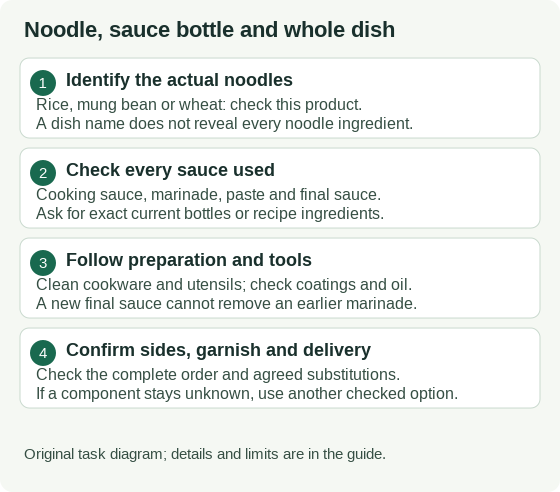
Thai dish names do not identify all ingredients
Thai food can be suitable for a gluten-free diet when the exact ingredients and preparation fit the requirement. The useful question is about this noodle product, these sauce bottles and this complete dish, not whether all pad Thai, curry or fried rice is gluten-free.
The Celiac Disease Foundation distinguishes plain rice and mung bean noodles from wheat-containing noodle types, and identifies traditional soy sauce, marinades, coatings and shared frying oil as checks. A rice base therefore does not answer the sauce or preparation question.
Use a specific menu item as the starting point. Ask who can identify today’s ingredients and explain the kitchen process, and keep an unconfirmed component unconfirmed. A dish described as vegetarian, rice-based or served without bread does not establish its gluten status.
Ask which noodles are actually used
For a noodle dish, ask for the current noodle product or full house recipe. Do not assume that a dish name, the noodle colour or a previous order identifies what this kitchen uses. Plain rice or mung bean noodles and a wheat-containing noodle product need different ingredient answers.
Even where a suitable noodle base has been identified, check seasonings, sauces, broth and additions. The finished dish is not just the dry noodle ingredient. A gluten-free noodle substituted into an otherwise unchanged sauce does not resolve a wheat-containing sauce.
If the staff can identify only “Asian noodles,” ask for the exact product or recipe. If they cannot establish it, another dish may be a candidate after its own rice, ingredients and preparation are checked. Do not treat the switch from noodles to rice as automatic whole-meal approval.
Check the sauce bottles and earlier marinade
Ask which sauces enter during preparation, rather than only which bottle sits on the table. A cooking sauce, marinade, seasoning paste and final dipping sauce may be different products. Ordinary wheat-containing soy sauce used earlier in cooking cannot be removed by replacing the final drizzle.
For soy sauce or tamari, ask for the exact current product and relevant gluten-free information. Tamari is a sauce name, not a guarantee that wheat is absent. The single-bottle tamari guide helps read that product and the later serving path.
For fish sauce, oyster sauce, a curry paste or another purchased sauce, ask for the current bottle ingredients and any relevant gluten-free statement. This guide does not claim that every product in those categories contains gluten. It tells you not to borrow a claim from another brand or flavour.
For a house blend, ask for the full recipe and its component bottles. “Our sauce is homemade” identifies neither those ingredients nor their gluten-free information. The Celiac Disease Foundation’s guidance about sauces and marinades supports following these components into the complete recipe.
If a sauce is changed, confirm that the change happens before preparation and that the rest of the order can be prepared appropriately. “Gluten-free sauce available” is different from “the original dish was cooked with that identified sauce.”
| Stage | Ask about | Missing information to preserve |
|---|---|---|
| Earlier marinade | Which recipe or bottle was used before cooking? | A final sauce change does not identify the marinade. |
| Cooking sauce | Exact soy sauce, tamari or other current component product. | A sauce nickname does not establish the ingredients. |
| Paste, stock or seasoning | Full recipe or product list for the paste, broth or mix. | A rice or vegetable base does not identify additions. |
| Final sauce | Exact sauce served with the dish and its handling. | A suitable finishing sauce does not approve earlier ingredients. |
| Substitution | Which identified replacement is used and when? | Confirm the revised whole recipe before cooking. |
Questions for pad Thai, curry and fried rice
Pad Thai or another noodle dish: identify the noodle product and every sauce or seasoning used. Ask whether the kitchen can prepare the agreed version with appropriate clean cookware and utensils. A rice-noodle answer settles neither an unidentified sauce nor shared preparation.
Curry: ask for the actual paste, stock, sauce and other recipe ingredients, plus the protein, vegetables and sides included. A coconut-based appearance, dish colour or familiar curry name does not supply the paste’s complete ingredients. Keep a missing product answer separate from an assertion that all curries are unsuitable.
Fried rice: ask which sauces and seasonings are mixed in, whether any protein was marinated beforehand, and what cookware and utensils are used. “It is rice” identifies only a base, not the complete prepared dish.
Grilled or steamed option: ask whether the food was marinated, brushed with sauce or given an added seasoning. A cooking-method name does not mean there were no earlier ingredients. Check the accompanying sauce and sides too.
Crispy or fried component: identify any wrapper, coating or batter and ask about the oil. Use the shared-fryer guide for the oil-versus-basket distinction. Do not transfer a suitable rice-noodle answer to a wheat wrapper or unexamined coating.
Ask about cookware, utensils and the serving path
The ingredient conversation needs a preparation follow-up. The Celiac Disease Foundation recommends asking about clean or separate preparation space, cookware and utensils. Have the kitchen describe the arrangement for this order, including the wok or pan and the tools used to mix and transfer the food.
A statement that a wok is hot does not describe whether food residue has been removed. A fresh final plate does not explain the pan, utensils or earlier sauce. Ask about the actual process rather than inventing a temperature that makes gluten disappear.
Check how sauces are measured and served. A shared ladle or dipping bowl can introduce a separate handling question after the original bottle has been identified. The source ingredient information does not cover every action in a restaurant kitchen.
Keep the agreed substitutions and actual gluten-free requirement with the order. Before eating, confirm that the delivered dish matches the noodle type, sauce arrangement, sides and garnish discussed. If something is different or unknown, pause and ask for clarification.
A sauce-and-noodle script you can use
“For [exact dish], which noodle product and which sauce bottles or house recipe ingredients are used? Please include the marinade, cooking sauce, paste or stock, and the final sauce.”
“Can this version be prepared with ingredients that meet my actual gluten-free requirement, using appropriate clean cookware and utensils? If there is a coating or fried component, what are its ingredients and what else uses that oil?”
“Please record [agreed changes] before the kitchen prepares the dish. If a bottle, recipe or process cannot be identified, which other option can you check completely?”
If celiac disease or a separate allergy applies, state it accurately. A gluten-free soy sauce still needs its separate soy-allergy reading; no sauce substitution should be treated as an answer to every dietary need.
The whole-order card covers the broader handover. The sauce comparison shows six manufacturer examples. Neither transfers a claim to a restaurant’s unknown house sauce.
Keep the exact recipe question and a checked alternative
Write a narrow record such as: “rice noodle product identified; cooking sauce unknown; paste recipe not confirmed; no order placed while those ingredients remain unresolved.” Another might identify the exact sauce and preparation answer but leave a garnish question open. The record should say what was actually checked.
If changing the noodle or sauce creates an option the kitchen can explain, check the revised whole dish. If not, another menu item may be a candidate only after its own ingredients and preparation are identified. A plain-looking rice dish or a grilled protein is not automatically a verified fallback.
Arrange a suitable checked backup or another meal when the restaurant cannot answer. Keep the location and date with a useful answer and recheck relevant changes next visit. This guide is not a Thai restaurant rating, a kitchen inspection or a gluten measurement. For illness, suspected exposure or a personal dietary decision, seek appropriate healthcare advice rather than using taste or absence of an immediate reaction as a test.
Keep the facts and the next question
Download the plain-text record, or copy the fields below. Leave missing information marked unknown.
THAI RESTAURANT GLUTEN-FREE ORDER RECORD
Location, date and exact dish:
Actual dietary requirement:
Exact noodle or rice product:
Earlier marinade and component sauce:
Cooking sauce bottles and current varieties:
Paste, stock and seasoning ingredients:
Coating, wrapper or batter:
Frying-oil answer where relevant:
Clean cookware, wok/pan and utensils:
Sauce measuring and serving tools:
Sides and garnish:
Agreed changes before preparation:
Delivered dish matches the discussion:
Unknown ingredient or process:
Checked alternative and preparation:
Recheck next visit:
This record is an information aid, not a recipe guarantee or gluten test.
Try these reading checks
These are original fictional situations for practising the distinctions in this guide.
A fictional pad Thai uses identified rice noodles but an unknown cooking sauce. Does the noodle answer complete the check?
No. Identify the actual sauce, other ingredients and preparation. A suitable noodle base does not settle a different component mixed into the dish.
A restaurant offers gluten-free tamari at the table, but an earlier marinade used an unconfirmed sauce. Is the finished dish now checked?
No. The final bottle does not identify or remove the earlier marinade. Ask which sauce entered the recipe before preparation and check the whole revised order.
A fictional curry looks coconut-based and contains vegetables. Does its appearance establish the paste and stock ingredients?
No. Ask for the current paste, stock, sauce and complete recipe. This does not mean every such curry contains gluten; the stated facts simply do not identify this one.
A cook says the wok is very hot. Does that statement establish that gluten-containing residue was removed?
No. Heat is not a description of the actual cleaning and preparation process. Ask about appropriate clean cookware and utensils instead of inventing a gluten-removal temperature.
Sources and scope
The Celiac Disease Foundation supplies the noodle, sauce, marinade, coating, shared-oil and clean-preparation distinctions. The Thai menu examples apply those checks to a complete recipe without claiming a named dish always has particular ingredients. Product categories such as fish sauce or curry paste require an actual label or recipe; no restaurant, bottle or meal was tested for this guide.
Sources checked 2026-11-03. A check date records when the listed information was read; it does not mean the source or rules changed on that date. The examples, diagram and record are original teaching material.