Practical guide
Shared Fryers and Gluten-Free Food: 6 Restaurant Questions
A food made from gluten-free ingredients can still have cross-contact in oil shared with gluten-containing breaded products. Ask about the oil and the complete preparation before ordering. If that setup is shared or cannot be confirmed, choose an alternative whose ingredients and handling you can verify.
Ask about the dish, not just the potato
“The fries are made from potatoes” answers a base-ingredient question. It does not identify a coating, seasoning, sauce or the oil used to cook them. A menu symbol can be a useful starting point, but the current food and preparation still need checking.
The Celiac Disease Foundation lists French fries as a food to verify because of possible wheat-flour batter and cross-contact from fryers. It also identifies fried foods cooked in oil shared with breaded products as a cross-contact concern. These are two different questions: what goes into the food, and what it touches during preparation.
State the requirement accurately. If you are ordering for someone with celiac disease, say so rather than describing it only as a preference. Ask the staff member to check with the person who knows the kitchen's current process. Do not assume that removing an ingredient at the table reverses what happened during cooking.
Six questions you can use at the counter or table
- What is in this exact item? “Can you check the fries or other fried food, including any batter, coating, seasoning and sauce, for gluten-containing ingredients?” Ask for the current product or recipe, not a recollection of a previous version.
- What else uses the oil? “Are wheat-breaded foods, battered foods or other gluten-containing items cooked in the same oil?” This is more specific than asking whether the basket has a gluten-free label.
- What does ‘dedicated fryer’ mean here? “Is the oil and fryer kept separate for the gluten-free preparation, or are only the baskets separate?” Have the kitchen explain its current arrangement rather than relying on the word dedicated alone.
- How is the food handled before and after frying? “What happens with the baskets, tongs, trays, preparation surface and transfer to the plate?” The oil question does not cover every shared tool or serving step.
- Who can confirm the order process today? “Can the person who knows this setup confirm it, and can you record the gluten-free requirement with the order?” A previous visit or another branch is not confirmation of today's process.
- What is the alternative if this cannot be verified? “Can you describe an alternative dish's ingredients and preparation, including sauces and shared tools?” A grilled food or packaged side still needs its own relevant checks.
You do not need to recite all six questions at once. Begin with ingredients and oil. If the oil is known to be shared with gluten-containing breaded products, move to the alternative instead of spending time negotiating a different basket for the same oil.
Follow the answer through the preparation
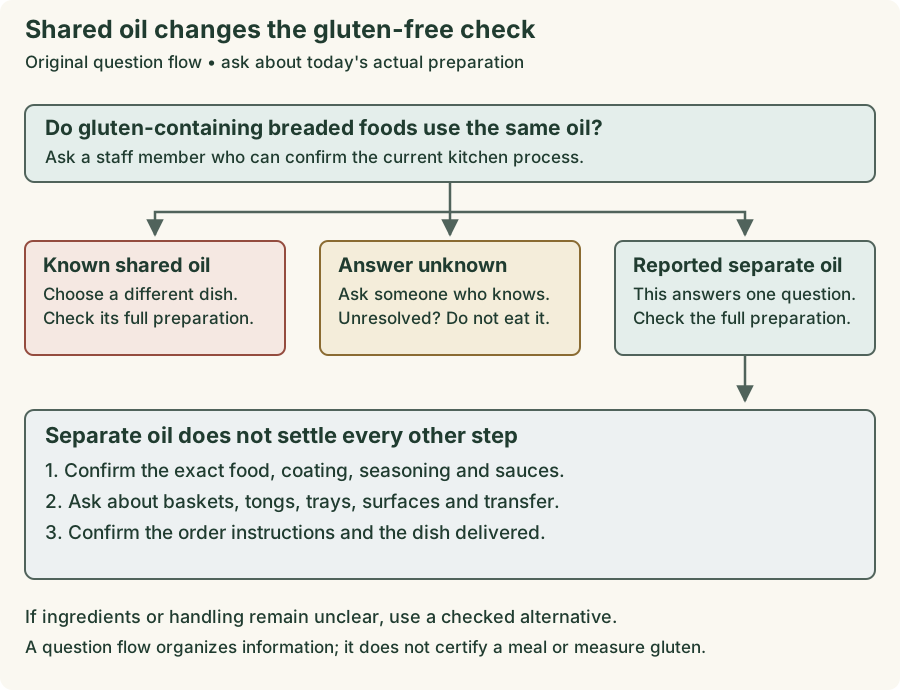
Download the question flow as SVG.
A known shared-oil answer identifies a concern that changing the wording of the order does not resolve. An unknown answer remains unknown until someone can confirm the process. A reported separate-oil answer lets you continue checking the food and handling; it is not a reason to skip those steps.
Turn a broad answer into a specific follow-up
| Reply | What it leaves unresolved | Useful follow-up |
|---|---|---|
| “There is no bread in the fries.” | Coating, seasoning, oil and handling. | Ask for the exact ingredient and shared-oil checks. |
| “We use a separate basket.” | Whether the basket enters oil used for gluten-containing breaded foods. | Ask whether the oil and fryer are actually separate. |
| “The oil is filtered.” | The full process and whether oil is shared. | Ask what else cooks in that oil; the statement alone is not verification. |
| “It should be fine.” | Which product and process have been checked. | Ask who can confirm the current ingredients and preparation. |
| “We have a gluten-free fryer.” | Exact food, coatings, tools, sauces and serving. | Continue with the remaining preparation questions. |
These are original illustrative replies, not reports from a named restaurant. The table helps you identify missing information; it does not measure gluten or evaluate a particular filtration system.
If the staff cannot answer, do not convert uncertainty into a reassuring yes. The Celiac Disease Foundation advises leaving food uneaten when ingredients cannot be verified. Apply that information boundary to the handling questions too.
Three examples of choosing the next question
Scenario 1: Plain fries, shared oil
The current ingredients are checked, but staff say the fries cook in the same oil as wheat-breaded onion rings. The ingredient answer does not remove the shared-oil concern. Choose another option and check its ingredients and preparation. A separate basket or picking crumbs off the served fries does not establish that this order avoids the shared-oil exposure.
Scenario 2: Separate oil, sauce not checked
The kitchen describes a separate fryer and oil. The dish also includes a sauce that staff have not identified. Continue with the sauce and serving checks rather than treating the fryer answer as a certificate for the whole plate. If a component is omitted, confirm the order before it is prepared and delivered.
Scenario 3: Another branch was fine last month
You remember a clear answer from another location, but today's staff cannot confirm the process. Keep the location and date attached to the information. Ask someone who knows the current arrangement; if it remains unclear, use a checked alternative rather than the previous branch's answer.
All three cases are original planning examples. A response that gives a current process is more useful than a general claim, but the reader's record still is not independent testing of that process.
A gluten-free claim does not replace the preparation questions
In the United States, FDA gluten-free labeling guidance explains a voluntary claim standard for FDA-regulated foods, including a less-than-20-parts-per-million requirement and other ingredient criteria. It also says restaurants' use of gluten-free labeling should be consistent with the federal definition, while state and local governments have an important oversight role.
That is guidance about the claim. Reading the menu does not let you calculate this meal's gluten concentration or establish that its preparation follows the claim. Do not use the label threshold as an allowance to eat from a known shared fryer.
This card organizes practical questions. It does not apply the US packaged-food rule as a universal legal standard in every country or identify a personal tolerance amount. Follow the gluten-free requirements relevant to your situation and use appropriate professional guidance for medical questions.
The oil distinction also matters in a shared home kitchen
The same cross-contact issue applies when a household fryer or cooking oil has been used for gluten-containing breaded foods. A label on the basket, a clean serving plate or a visible kitchen reminder does not change the oil's previous use.
Plan a preparation that avoids that shared-oil path, with the ingredients, tools and serving steps considered together. If that cannot be arranged or confirmed, choose another suitable food rather than treating “dedicated tools” as an answer to every concern.
This is not an equipment-cleaning or oil-reuse procedure. Use the equipment's instructions for operation and maintenance. The question flow helps identify the food-contact problem; it does not validate a home cleaning method or certify an appliance as gluten-free.
Keep a short record, then check the next visit again
Download the editable fried-food question record. It keeps the exact location, dish, oil answer, handling details, unanswered questions and alternative together.
Dish considered: fries with a dipping sauce
Ingredient answer: exact product still needs checking
Oil answer: shared with wheat-breaded food
Decision: choose another dish
Alternative check: ingredients, sauce and preparation still needed
Next visit: ask about the current process again
Write the actual answer, such as “oil shared with breaded food,” rather than “restaurant passed.” Keep who answered and when beside it. Staff, suppliers, recipes and equipment use can change, so a previous record is a starting point for rechecking rather than a permanent approval.
Before eating, confirm that the delivered dish matches the order discussed. If it does not, pause and ask for clarification. Removing an unexpected breaded garnish after serving does not tell you whether it already contacted the rest of the food.
Three checks before relying on a fryer answer
Use these original cases to distinguish the ingredient, oil and handling questions.
Case 1
The fries have checked gluten-free ingredients and a labeled basket, but use oil shared with wheat-breaded foods. Have those checks resolved the oil concern?
Show answer and explanation for case 1
No. Ingredients and a basket label do not resolve shared oil.
Choose an alternative with its own ingredients and preparation checked. The Celiac Disease Foundation identifies oil shared with breaded products as a cross-contact concern.
Case 2
The fryer and oil are reported to be separate, but nobody can identify the sauce. Is the complete plate verified?
Show answer and explanation for case 2
No. Continue with the sauce and serving questions.
The oil answer covers one stage. An unknown component remains unknown; ask for current information or use a checked alternative.
Case 3
Can a clear answer from a different location last month replace the current staff answer?
Show answer and explanation for case 3
No. Check this location and today's process.
The food, suppliers, handling and equipment use can differ. Keep the location and date with the record and recheck before relying on it.
Sources and further reading
- Celiac Disease Foundation: Sources of GlutenFrench-fry batter and fryer cross-contact, shared oil with breaded products, shared utensils and cooking environments, and leaving unverifiable food uneaten.
- FDA: Gluten and Food LabelingUS FDA-regulated-food claim scope, less-than-20-ppm standard and FDA wording about restaurant claims and state/local oversight. No meal measurement or universal legal equivalence is claimed.