Practical guide
Barley Malt vs Maltodextrin: Gluten-Free Label Differences
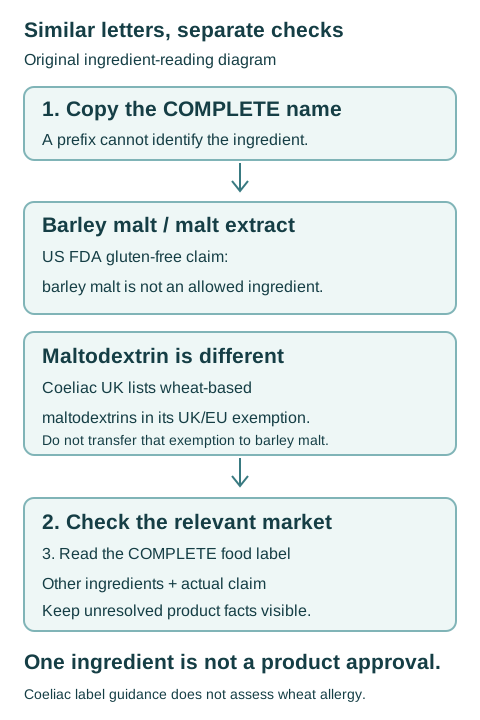
Read the whole ingredient name and the relevant market before deciding. Barley malt and maltodextrin are different ingredients; FDA claim restrictions and Coeliac UK’s specific processed-ingredient exemption answer different questions. Use the diagram, record and eight fictional cases to keep that distinction clear without approving a whole product from one word.
The shared letters do not give the same answer
Barley malt and maltodextrin are different ingredients. Do not reject a food merely because the word maltodextrin begins with “malt,” and do not treat barley malt as gluten-free because it appears in a small quantity. Read the complete ingredient name and the rules relevant to the market where the food is sold.
For FDA-regulated packaged foods in the United States, barley malt and barley malt extract cannot be ingredients in a food bearing a gluten-free claim. The FDA rule combines ingredient restrictions with a gluten limit; a number below 20 parts per million does not cancel the restrictions. Coeliac UK, meanwhile, specifically lists wheat-based maltodextrins among processed cereal-derived ingredients exempt from naming the original cereal in UK/EU allergen labelling. Its guidance says those listed ingredients are safe for people with coeliac disease.
Those statements answer different questions. One concerns a particular ingredient in a US gluten-free-labelled food; the other explains a processed-ingredient exemption in UK/EU label reading. Neither lets you approve an entire product from one word. Keep the rest of the ingredient list, the actual claim and any unresolved product question in view.
Copy the whole word before classifying it
At the shelf, copy the ingredient exactly rather than turning it into a shorter nickname. “Malt extract,” “barley malt” and “maltodextrin” should occupy separate lines in a comparison record. A search for the fragment “malt” can flag a line for reading, but it cannot make the final ingredient decision.
| Exact wording | What the wording means here | Useful next check |
|---|---|---|
| Barley malt | A malt ingredient explicitly naming barley. | US FDA gluten-free claim: barley malt is not an allowed ingredient. |
| Malt extract / malt syrup | FDA describes these unqualified terms as extracts of germinated barley. | Do not assume “barley” must appear beside the word before you need to notice it. |
| Maltodextrin | A different processed ingredient; the shared prefix is not an ingredient identity. | Do not silently substitute “barley malt” for the word you actually read. |
| Wheat-based maltodextrin | Coeliac UK names this processed ingredient in its UK/EU exemption list. | That coeliac guidance does not assess the whole product or a person’s wheat allergy. |
| Glucose syrup / dextrose | Coeliac UK separately lists glucose syrups based on wheat or barley, including dextrose. | The exemption is specific. Do not extend it to every ingredient derived from those cereals. |
| Malt vinegar | A barley-derived fermented product in the FDA Q&A. | FDA distinguishes it from distilled vinegar; fermentation is not gluten removal. |
Keep this table beside the current package, not as a permanent approval list for familiar brands. If you have only an old online ingredient image, it may not describe the product in your hand. Match the exact variety and market, and preserve a question when the wording is missing or inconsistent.
United States: a low test number does not override the ingredient rule
The FDA’s gluten-free rule applies to foods within its labelling authority, including dietary supplements. Its Q&A explains that some meat, poultry and egg products fall under USDA rules, while many alcoholic beverages are regulated by TTB. Use the relevant authority instead of applying the FDA packaged-food answer to every menu, bottle or jurisdiction.
Under the FDA rule, a food using a gluten-free claim must meet the ingredient conditions and contain less than 20 ppm gluten. An intentionally added gluten-containing grain, or a grain-derived ingredient that has not been processed to remove gluten, cannot be excused merely because the finished food measures below that level. “Only a little barley malt” and “our test was low” therefore do not supply the missing ingredient compliance.
The Q&A specifically says malt extract and malt syrup are water extracts of germinated barley that have not been processed to remove gluten. It states that barley malt and malt extract cannot be used in foods bearing a gluten-free claim. This is why a US package showing both a gluten-free claim and barley malt calls for resolving an apparent contradiction, rather than inventing a safe serving size.
Hydrolysis and fermentation also need careful language. FDA explains that these processes do not themselves remove gluten, and that available tests have limitations for measuring gluten fragments in fermented or hydrolysed foods. Its record requirements address the food before those processes. A vague claim that “processing takes care of it” is not the same as identifying a compliant ingredient.
If you encounter the contradiction, retain the actual package wording and ask the manufacturer to clarify the current ingredients and claim for that exact US product. Choose another suitable option while it is unresolved. A reassuring statement cannot rewrite the FDA condition if barley malt really remains an ingredient. This guide has not tested the package, assessed a batch or confirmed a manufacturer response.
UK/EU label reading: understand the specific maltodextrin exemption
Coeliac UK explains that cereals containing gluten must be named as specific cereals and emphasised in ingredient lists under UK/EU allergen labelling. Examples include wheat and barley. A reader looking only for a US-style “Contains wheat” line can miss how this label is organised; inspect the ingredient list itself.
The same source lists exceptions for some ingredients derived from cereals containing gluten where gluten has been removed in processing. It specifically includes wheat-based maltodextrins and glucose syrups based on wheat or barley, including dextrose. It says these listed ingredients are safe for people with coeliac disease and do not need the original cereal listed.
Use that precise exemption. It does not say ordinary barley malt is maltodextrin, and it does not create a blanket exemption for every wheat- or barley-derived ingredient. Nor does the absence of an emphasised cereal name prove which source a particular maltodextrin used; the guidance explains why a source cereal need not be declared for the listed exemption.
Keep the country boundary explicit. The UK/EU exemption helps explain an ingredient and its allergen disclosure in that setting. It does not replace US claim requirements, and the US barley-malt claim answer should not be pasted onto a differently regulated product as a universal legal conclusion. For an unresolved local label, use the appropriate local coeliac organisation or manufacturer’s current product information.
This is guidance for gluten-free/coeliac label reading. Wheat allergy is a different question. Do not turn an exemption described for people with coeliac disease into a personalised wheat-allergy assurance. Use the applicable allergy guidance and qualified advice for that need.
A recognised ingredient does not approve the finished food
After identifying maltodextrin correctly, continue reading. A product may contain another ingredient that changes the decision. A correct interpretation of one line does not erase barley malt, wheat-containing ingredients, an unresolved claim or a manufacturing concern elsewhere on the same package.
“Wheat-free” and “gluten-free” answer different questions. In a US allergen statement, the absence of wheat does not rule out barley or rye. Conversely, a processed ingredient and a gluten-free claim can require a more specific reading than rejecting every word linked to wheat. Follow the complete applicable label, not a rule made from one prefix or one allergen line.
Read advisory statements as actual statements about that product and market. Coeliac UK describes “may contain” wording as voluntary and tied to assessed cross-contamination risk. FDA says a truthful wheat-facility advisory can appear with a gluten-free claim, but that claim must still meet its requirements. These points do not establish the condition of a particular food or create one worldwide instruction for all advisory labels.
Preserve what remains unknown. If a label photograph is incomplete, a restaurant cannot identify the ingredient, or a manufacturer answer describes a different flavour or market, you still have a product question. Ask for the missing fact or select a suitable alternative. Do not test personal tolerance by eating a little of an unresolved food.
For a changed familiar package, use the packaging-change recheck to compare old and current wording. That guide organises the changed-label task; this page explains why these similar ingredient names require different readings.
Practise with eight fictional label decisions
These are original teaching scenarios, not checked brands or real manufacturer responses. Decide what the wording actually supports before opening each explanation. A useful answer can be “unresolved”; the exercise is not to approve every product.
Case 1
A fictional US cereal package lists barley malt and also says gluten-free. Can you reconcile the two by noting that malt is a minor ingredient?
Show answer and explanation for case 1
No. Treat the combination as an unresolved contradiction.
FDA restricts intentionally added barley malt in foods bearing a gluten-free claim; the rule is not merely a finished-food concentration threshold. Save the exact wording and seek clarification for that current product. Choose a suitable alternative while the contradiction remains, rather than inventing a safe portion.
Case 2
A fictional UK ingredient list includes maltodextrin. Someone crosses it out because the word begins with malt. What should you correct?
Show answer and explanation for case 2
The prefix does not make maltodextrin the same ingredient as barley malt.
Coeliac UK specifically includes wheat-based maltodextrins in its processed-ingredient exemption guidance. Read the complete current food label rather than replacing the printed word with a different ingredient. This corrects the name interpretation; it does not confirm the product’s other ingredients or an individual allergy decision.
Case 3
A fictional US sweet lists malt extract but its allergen line does not mention wheat. Is the allergen line enough to rule out gluten?
Show answer and explanation for case 3
No. Keep reading the ingredient list and the claim.
FDA describes unqualified malt extract as derived from germinated barley. A wheat-only allergen check does not identify every gluten-containing cereal. Do not require the separate word barley beside malt extract before recognising this US ingredient issue.
Case 4
A fictional UK food lists maltodextrin and barley malt on separate lines. Does the maltodextrin exemption settle both?
Show answer and explanation for case 4
No. The exemption for one ingredient cannot be transferred to another.
Keep the two names separate and assess the complete product under the relevant local label guidance. Coeliac UK’s specific wheat-based maltodextrin exemption does not reclassify ordinary barley malt. Do not apply a foreign claim rule as if it were the local law.
Case 5
A seller says a fictional US food with added barley malt tested below 20 ppm, so the gluten-free claim must comply. Is that complete?
Show answer and explanation for case 5
No. The ingredient restrictions still matter.
FDA requires the gluten-free claim to satisfy both the ingredient conditions and the less-than-20-ppm limit. A low result does not allow intentionally added barley malt under that claim. Do not confuse a numerical result with evidence that every part of the rule has been met.
Case 6
An ingredient list has a UK/EU processed-ingredient exemption. Does that establish suitability for someone with wheat allergy?
Show answer and explanation for case 6
No. This coeliac/gluten reading does not answer the individual allergy question.
The cited Coeliac UK statement describes safety for people with coeliac disease and cereal disclosure exemptions. It does not provide a personalised assessment of wheat allergy. Keep that separate need visible and use the applicable allergy advice instead of transferring the conclusion.
Case 7
A manufacturer’s reply discusses a different flavour sold in another country. Can you attach it to the package you are checking?
Show answer and explanation for case 7
Keep the current product question unresolved.
A useful reply must match the exact product, variety, current ingredients and market. Record the mismatch and request the missing applicable information, or choose another suitable product. The shared brand name does not establish matching ingredients, claims or regulatory context.
Case 8
A fictional product says its barley ingredient was fermented. Does that alone establish gluten removal?
Show answer and explanation for case 8
No. Fermentation is not itself evidence of removal.
FDA distinguishes fermentation and hydrolysis from processes that remove gluten and explains limits in testing the resulting fragments. Ask what actual ingredient and applicable claim are being described. Do not reinterpret ordinary barley malt or malt vinegar as a distilled ingredient simply because processing occurred.
Keep a short record that separates wording from conclusion
The printable record is useful when comparing similar packages or asking about an ambiguous label. Copy facts first, then write the interpretation beside them. A line saying “malt checked” loses exactly the distinction this guide is meant to preserve.
| Record field | Copy these facts | Then ask |
|---|---|---|
| Market and exact product | Country/market, product name, variety and package version. | Does the guidance and any reply apply to this actual package? |
| Exact ingredient wording | Copy each relevant name on its own line. | Have you confused maltodextrin with barley malt or omitted another ingredient? |
| Claim and other statements | Copy the full claim, cereal/allergen wording and relevant advisory. | Do the statements agree under the applicable local rules? |
| Source and unresolved question | Record the relevant source, any current product-specific answer and remaining uncertainty. | What specific fact is still needed before relying on the product? |
Download the blank label record and eight worked explanations. It includes space for three products. Mark missing information as unrecorded, and distinguish an old online image from the label currently in front of you. Recording a source or reply does not mean the food has been laboratory tested.
If another person shops for you, share the specific product question and suitable backup rather than a vague instruction to avoid every word beginning with malt. For example, “Please keep barley malt and maltodextrin separate in the ingredient check, and use the current package for this market” is clearer than “malt words are all bad.” The record should support the next decision, not become a permanent brand guarantee.
Choose the next page for the question you actually have
For ordinary barley as a food, start with Is Barley Gluten-Free?. For malt ingredients and their practical replacement question, use Is Malt Gluten-Free?. Those pages address the ingredient itself; this comparison separates similar names and their market-specific label context.
For a changed bottle of sauce, the tamari, coconut aminos and soy sauce comparison answers a different product-choice task. Do not use the maltodextrin exemption to approve a sauce without reading its current ingredients and applicable claim.
The sources below establish the cited regulatory conditions and label-reading exemptions. They do not establish your product’s current formula, batch or handling, and this guide does not provide a diagnosis, treatment plan, safe gluten dose or wheat-allergy assessment. If a product appears related to a health problem, obtain appropriate healthcare advice rather than relying on this worksheet or experimenting with personal tolerance.
Sources and further reading
- FDA: Questions and Answers on Gluten-Free Food LabellingUS FDA scope, ingredient restrictions plus less-than-20-ppm limit, barley malt/extract/syrup, fermentation and hydrolysis limits, and gluten-free/advisory claim context.
- Coeliac UK: How to Read Food LabelsUK/EU named-cereal disclosure, specific wheat-based maltodextrin and glucose-syrup exemptions, current-label and advisory wording context. Coeliac guidance does not establish an individual wheat-allergy decision.