Practical guide
Gluten-Free Condiments in a Shared Kitchen: A Practical Checklist
Check the exact condiment first, then protect it after opening. Keep a separate labeled container or a prior clean portion, use clean serving tools, and stop bread-contact knives, squeeze tips and serving leftovers from carrying gluten back to the stock.
Check the product and the serving path separately
A condiment with suitable gluten-free ingredients can still receive crumbs from a knife used on wheat bread. Start with the exact product, then protect it after opening: keep a clearly labeled separate container, use clean serving utensils, and keep bread-contact tools and leftovers out of the stock container.
The Celiac Disease Foundation identifies double-dipped utensils as a cross-contact route for butter, peanut butter, jam, mustard and mayonnaise. Beyond Celiac recommends separate, clearly labeled gluten-free condiments and explains that a squeeze bottle only helps when its tip does not touch gluten-containing food.
This guide turns those points into an original household routine, labels and practice cases. It does not identify the gluten concentration of a jar or certify a kitchen. Use the gluten-free requirements agreed with your clinical team when you have celiac disease; a personal kitchen sticker does not replace the product's own information.
Check the current product name, variety, ingredient list and relevant gluten-free information before reserving it. Flavored butter, a sauce blend and a plain spread are separate products. “Wheat-free” is not the broader gluten-free answer. For US FDA-regulated foods, a gluten-free claim has ingredient criteria and a less-than-20-ppm requirement. That packaged-food rule does not measure what later entered an open jar.
Use the packaging-change label guide if the exact product is uncertain. The rest of this page assumes that initial product question has been resolved.
Look for the tool-to-food-to-container return path
Ask what touches the condiment rather than judging only what the condiment is made from. The key event can happen in a second: scoop, spread on bread, scoop again. A gluten-free statement on the original label cannot tell you that this second scoop never occurred.
| Container or food | Contact path to notice | Practical control |
|---|---|---|
| Butter, soft cheese or spread tub | A spreading knife touches wheat toast, then returns to the tub. | Reserve a checked separate tub; serve with a clean tool that has not touched the bread. |
| Jam, peanut butter or mayonnaise jar | A used knife or spoon enters the stock jar. | Keep the stock scoop clean and put a portion in a separate bowl before spreading. |
| Mustard or sauce bottle | The nozzle is wiped on a sandwich, burger bun or used spoon. | Dispense without contact; explain the no-contact rule to everyone using it. |
| Dip at a shared table | A wheat pretzel or cracker enters the dip. | Serve a separate checked portion with its own clean serving tool before shared dipping begins. |
| Portion bowl | A used spreader enters the bowl; remaining food is poured back. | Keep served portions out of the stock container, including unused-looking leftovers. |
| Decanted container | The product identity is lost, or a dirty container is reused. | Use a clean food-safe container and retain the exact product, date and handling rule. |
These are original examples of applying the sources' utensil and shared-container guidance. They are not observations of a named household or tests of a particular packaging design.
Also check hands, the work surface and where a scoop is put down. A clean spoon laid on a crumb-covered board is no longer protected by the fact that it started clean. Keep the serving task away from bread preparation, and place the stock scoop on a clean rest rather than on a sandwich plate.
Do not use a color, a shelf position or “we usually remember” as the complete rule. Those cues can help people find the right container, but the handling instructions need to be readable and understood.
Portion from protected stock before bread contact
A separate jar or tub is often the simplest household arrangement. If you divide a newly opened suitable product, do so while its stock and utensils are still protected. Portioning does not restore a jar that has already received a bread-contact knife.
- Identify the stock. Check the exact product and use a container that has not already been used with gluten-containing food.
- Prepare the receiving container. Use a clean food-safe bowl or container, a clean scoop, clean hands and a clean work area.
- Take the portion before spreading. Transfer what is needed, then close and put away the stock before bread-contact utensils appear.
- Use the portion for that serving. Keep its spreading or dipping tools with that portion. Do not return them to the stock jar.
- Keep leftovers out of stock. A bowl that entered the serving area does not become protected stock because some food looks unused.
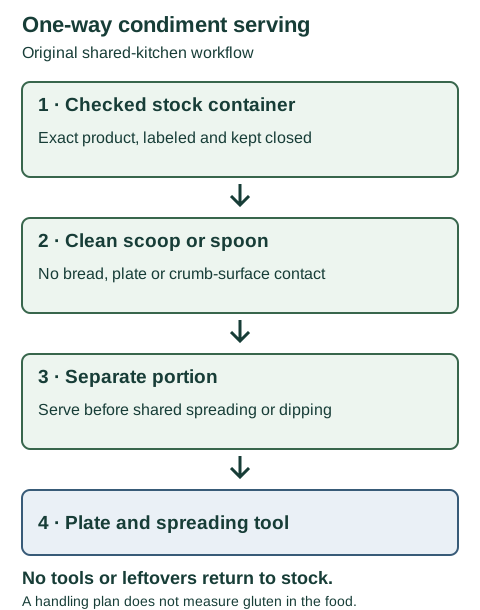
For a busy breakfast, arrange the checked portion before the shared toast, knives and plates reach the counter. A household member can then take a spoonful from the portion bowl without entering the reserved jar. Keep a clean stock scoop available if another protected portion is needed; the used spreading knife is not that scoop.
Use the product's opened-storage instructions for any decanted portion. Moving food to a smaller container does not create a new shelf life. Keep refrigeration needs and ordinary food hygiene separate from gluten control.
Use squeeze bottles with a no-contact rule
A squeeze bottle can avoid inserting a knife into a jar, but its tip can still touch bread, a used utensil or a crumb-covered plate. Beyond Celiac describes squeeze bottles as useful only when users know not to wipe the tip on gluten-containing food.
Hold the nozzle clear of food and utensils when dispensing. Keep the cap and bottle exterior out of the bread-preparation mess, and close the bottle after use. Tell guests the rule before they use it; a label alone does not explain what “no contact” means.
If you know the nozzle touched wheat bread, stop using that bottle as the protected gluten-free option and tell the other users. Wiping what you can see off the tip is not verification of the contents or the complete contact path. Use another checked, protected option while the issue is unresolved.
Individual packets are another practical way to separate portions when their exact product information has been checked and they are opened and handled appropriately. A small packet is not automatically gluten-free, and an unmarked packet cannot be identified by its size or appearance.
Choose the arrangement people will actually follow. A separate jar with a clear scoop rule may work better in one home, while checked individual portions may be easier for a guest breakfast. No packaging format eliminates the need for the initial ingredient and product check.
Label the product, the rule and the exception
Use words as well as colored tape. “Reserved gluten-free use” describes your intended kitchen handling; it is not a manufacturer's gluten-free claim, certification symbol or test result. Check the product first, and keep its original label or a reliable identifying record.
These three original templates separate protected stock, a serving portion and a container set aside after a mistake. Fill them with the actual product and event; do not invent an opening date or a confirmation you do not have.
Stock label
RESERVED GLUTEN-FREE USE
Exact product: __________________
Opened / checked: _______________
Clean scoop only.
No bread-contact knife or spoon.
Close and return to its marked place.
Wrong tool used? Stop and tell others.
Portion label
SERVING PORTION
Exact source product: ___________
Portioned on: ___________________
Use this portion's own utensil.
Do not return tools or leftovers
to the stock container.
Follow product storage instructions.
Incident label
SET ASIDE - NOT FOR GLUTEN-FREE USE
Container / product: ____________
Known or uncertain contact: _____
Recorded by / date: _____________
Tell the next person before serving.
Use a separate checked alternative.
Mark the lid and a visible side if the containers are stacked or stored with similar products. Put the handling rule where the person taking a scoop will see it. Keep containers closed in an identifiable area while following normal food-storage rules; a gluten label does not override refrigeration or separation of raw and ready-to-eat food.
If you decant, retain the exact brand and variety, relevant ingredient information, product storage instructions and the source of any gluten-free confirmation. “Jam” or “GF sauce” on a mystery tub is not enough to reconnect it to an exact product.
Run this checklist before serving
| Check | What to arrange | What to catch |
|---|---|---|
| Product | Exact current variety and suitable gluten-free information checked. | If unclear, resolve it or use a checked alternative. |
| Stock | Separate protected jar/tub or a prior clean portion identified. | Do not portion from a jar after known bread-contact dipping. |
| Utensils | Clean scoop stays away from bread, plates and crumb surfaces. | Keep a used spreading knife with its own serving. |
| Cleaning | Washable utensils cleaned thoroughly; clean drying and cleaning materials used. | Do not treat a quick rinse or disinfectant as proof of gluten removal. |
| Serving | Portions and stock have a one-way path. | No returning serving leftovers or tools to stock. |
| Bottle | Nozzle does not touch food or used utensils. | Pause after contact; do not rely on wiping visible residue. |
| Storage and handoff | Containers closed, identified, stored as directed; others know the rule. | Explain mistakes promptly and leave a visible set-aside note. |
For washable dishes and utensils, Beyond Celiac describes removing food residue, washing thoroughly with warm soapy water, rinsing, and using a dishwasher where appropriate. Dry with a clean towel or air dry, and avoid using a gluten-residue-laden sponge, dish rag or wash water on the items you are protecting.
Gluten is a protein, not a bacterium you can “kill.” Cleaning food residue from a utensil is a different task from microbial sanitation, and neither a heated jar nor a sanitizer statement establishes that gluten was removed from its contents. Do not apply this simple utensil routine as a cleaning protocol for every porous board or complex appliance.
The checklist is a memory aid, not a scored safety test. Seven completed rows do not measure the jar's gluten concentration or cancel an actual mistake. If the product or handling remains uncertain, pause that option and use a checked protected alternative.
Six shared-condiment cases to practise
These original fictional situations test the product, container and return-path distinctions. They are not reports of gluten-tested meals.
Case 1
The jar label is gluten-free, but a knife returns after spreading on wheat toast. Does the original claim settle the open jar’s handling?
Show answer and explanation for case 1
No. The bread-contact return introduces a new concern.
The label described the product, not every action after opening. Keep that jar out of the protected gluten-free rotation, tell other users, and use a separate checked option. A new clean spoon does not reverse the earlier dip.
Case 2
A squeeze-bottle tip touches a wheat sandwich. Does wiping off the visible smear establish protected use?
Show answer and explanation for case 2
No. Treat the contact as an incident, not a verified reset.
A squeeze bottle helps only if its nozzle stays clear of gluten-containing food and utensils. Stop using it as the protected option and tell others. Do not infer the condition of its contents from a clean-looking tip.
Case 3
A jar has received crumbs. Can you scrape off the top, then create a “clean” gluten-free portion from underneath?
Show answer and explanation for case 3
No. That does not establish that the remaining condiment avoids the contact.
Portion from checked protected stock before bread contact, not after it. Appearance cannot tell you where gluten-containing material moved within a spread. Set aside the affected stock and obtain a separately checked alternative.
Case 4
A serving bowl has been used with wheat crackers. Can its unused-looking dip be returned to the stock tub?
Show answer and explanation for case 4
No. Keep serving leftovers out of stock.
The bowl and its utensils entered a shared food-contact setting. Returning the remainder creates a route back to the tub. Use a one-way serving path and take another protected portion with a clean stock utensil if needed.
Case 5
A guest receives an unmarked small condiment packet. Does separate packaging alone settle the ingredient question?
Show answer and explanation for case 5
No. Identify and check that exact product.
An individual packet can help separate serving, but it does not prove what is inside. Ask for matching product information or choose a checked alternative. Keep the product check separate from the later handling check.
Case 6
Someone accidentally uses the wrong knife, then quietly puts the lid back because the jar still looks fine. What should change?
Show answer and explanation for case 6
Tell the next users and set the container aside from gluten-free use.
Beyond Celiac explicitly encourages reporting kitchen mistakes. Record the actual known or uncertain contact, label the container clearly, and use another checked protected option. The aim is a useful handoff and a better routine, not blaming the person or testing the jar by taste.
Make the next serving clear after a mistake
Use a brief, specific handoff: “This knife touched wheat toast and went into this jar. I have set the jar aside from gluten-free use. Here is the separate checked option for this serving.” If the event is uncertain, say what is unknown instead of recording a definite exposure or a definite clearance.
Keep the affected container identifiable so someone else does not unknowingly choose it. Do not taste the food or wait for symptoms as a way to test whether the handling was acceptable. For suspected exposure or symptoms, follow your clinical team's advice; this guide cannot assess your medical situation.
Then change the setup that allowed the return: provide a clean stock scoop, portion before toast is prepared, move similar jars apart, or explain the squeeze-tip rule. A repeatable adjustment is more useful than asking everyone to remember an invisible exception.
Download the three labels, seven-check serving sheet and six explained cases. Keep the record in your kitchen; you do not need to submit personal or medical details.
For sauce choice, the tamari, coconut aminos and soy sauce comparison answers the exact-bottle question. The single-bottle soy sauce guide connects that check to the complete dish. For frying oil, use the separate shared-fryer question guide; a clean condiment spoon does not answer an oil-use question.
Sources and further reading
- Celiac Disease Foundation: Sources of GlutenShared utensils and storage, double-dipped butter/peanut butter/jam/mustard/mayonnaise, ingredient uncertainty and wheat-free versus gluten-free.
- Beyond Celiac: Cross-ContactSeparate clearly labeled condiments, squeeze-tip contact, shared dip, reporting mistakes, washable utensil cleaning and clean drying materials. Other appliance and flour-time claims on this broad page are not adopted.
- FDA: Gluten and Food LabelingUS FDA-regulated packaged-food scope, voluntary gluten-free claims, ingredient criteria and less-than-20-ppm requirement. No concentration is inferred for an opened household container.