Certified Gluten-Free vs Gluten-Free: Check the Mark and Product
A gluten-free claim must meet the applicable food-labelling rules. A certification mark adds a named private program. To use that extra information, match the issuer, exact current product, market and mark; a brand name or approved factory does not certify every item.
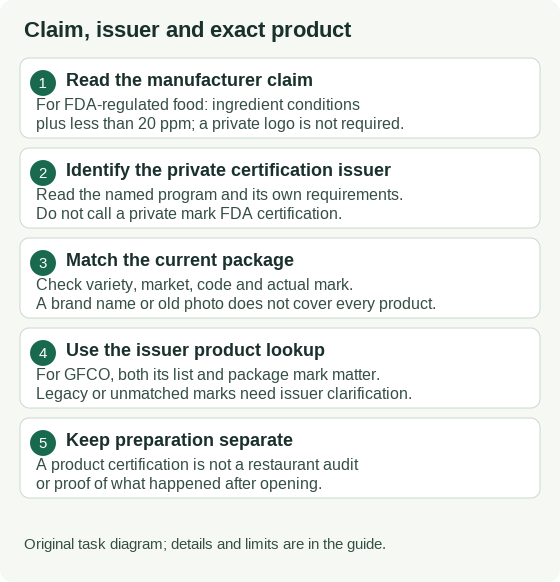
The legal claim and private certification have different jobs
Gluten-free is a regulated claim for US FDA-regulated food; certified gluten-free adds a named third-party program. A manufacturer is responsible for complying with FDA requirements when it uses the claim. A private certification program can add its own product, ingredient, manufacturing and verification requirements.
Do not turn this distinction into “plain gluten-free is unregulated.” The FDA rule applies to the equivalent words gluten-free, no gluten, free of gluten and without gluten. Ingredient restrictions and less than 20 ppm gluten apply whether or not the manufacturer also displays a certification symbol.
Equally, FDA does not endorse, accredit or recommend a particular third-party gluten-free certification program. “FDA-certified gluten-free” is not an accurate name for an ordinary private mark. If a package carries a symbol, identify its issuer and what that program says it covers.
This guide explains a US FDA claim and uses GFCO as one specific private-program example. It does not compare every certification scheme or recommend a universal certification requirement for every food. Your own dietary plan may include a particular requirement; preserve that requirement rather than deriving one from a logo comparison.
| Observation | Who supplies the requirements? | Useful next check |
|---|---|---|
| Manufacturer uses gluten-free on an FDA-regulated food | FDA requirements; manufacturer responsible for compliance. | Read the current claim and ingredients; resolve an apparent inconsistency. |
| Package has a private certification mark | The named certification issuer, in addition to applicable law. | Match the issuer, exact product and current mark to its verification instructions. |
| Website says a plant is approved | The issuer describes what that facility listing means. | Do not assume every product made there is certified. |
| A restaurant says it uses a certified product | The certification applies to its product scope. | Check the complete dish and later handling; a bottle claim does not inspect a kitchen. |
What the GFCO example actually adds
GFCO, the Gluten-Free Certification Organization, is a program of the Gluten Intolerance Group. Its current website describes a product-certification process based on review of submitted products and ingredients, with facility audits for compliance with its standard.
Its program summary says starting ingredients and finished products must test below the applicable gluten-free threshold in the country of sale or 10 ppm, whichever is lower. It also identifies country-specific conditions such as the prohibition of oats where that is required. This is a description of GFCO’s own requirements, not a replacement definition of the FDA claim.
The same summary describes testing requirements tailored to risk. Do not rewrite that as “every certified brand tests every batch,” “all certification schemes use 10 ppm” or “certified means zero gluten.” The named issuer, its current requirements and the actual product scope matter.
The full GFCO manual is linked from its certification page. The summary here uses the official program overview, certification process and consumer product-finder instructions. It is not a claim that this website has audited a facility, reviewed a certification application or examined a product’s test records.
A lower program threshold is a difference in program requirements. It does not let this guide promise an individual medical outcome or calculate a safe serving size. For the FDA meaning itself, use the gluten-free label-meaning guide.
How to check a mark on the package in your hand
- Write down the exact item. Keep the brand, full variety, country of sale, size or product code where available, and the current package. A brand can sell both certified and non-certified varieties.
- Identify the issuer. Read the program name and actual mark. A generic badge saying “gluten friendly” or a retailer icon is not proof of membership in a named certification program.
- Open the issuer’s official product lookup. GFCO’s Product Finder offers name, keywords or UPC, brand, category and sales-region fields. Use the information that identifies your product rather than assuming a similar name is the same item.
- Match the package as well as the listing. GFCO says products are considered certified when they appear on its list and carry the relevant certification mark. It says a listed product whose package does not carry the mark is not certified.
- Keep mismatches open. GFCO instructs consumers to seek its clarification when a marked product cannot be found, and to confirm certification for legacy-mark cases. Follow the issuer’s actual instructions instead of deciding from an old logo image or treating a missing search result as an independent gluten test.
The record below helps identify the package and the specific discrepancy for your own follow-up with the issuer.
If you use another certification program, follow that issuer’s own current lookup and mark rules. The GFCO list-and-mark instructions in this section are not a universal claim about every third-party scheme.
Do not transfer certification beyond its scope
A product listing does not certify every food a brand makes. Similar artwork, a different flavour, a food-service size or a version sold in another country may need a separate match. Match the exact item instead of using “this brand is certified” as a buying rule.
GFCO’s manufacturer-listing description is explicit: it lists facilities approved to manufacture GFCO-certified products, but GFCO does not certify manufacturing facilities, and product certification requires a separate application. An approved plant therefore cannot be used to infer that every item leaving it carries product certification.
A current manufacturer page can help identify a product and its published claim. It is still different from inspecting your package or an issuer’s product record. For example, the sauce comparison distinguishes a wheat-containing tamari from a separately named gluten-free tamari in the same brand. The certification information for one cannot be transferred to the other.
Use the six-product sauce comparison for that illustration. It shows why exact varieties matter; it does not certify a bottle merely because it resembles an example.
A missing or changed logo is a specific question
A logo disappearing from a redesigned package is an observation about the mark. It does not by itself prove that gluten was added, that the food was tested, or that the separate manufacturer gluten-free claim disappeared. Read every panel before recording the change.
Record the manufacturer’s current words and the issuer mark separately. If the mark is not visible, do not call this package certified merely because an older photograph displayed it. Conversely, do not describe a still-present gluten-free statement as meaningless because the private symbol changed.
The packaging-change worksheet compares old and current claim positions, ingredients and symbols. Use that focused tool if the redesign is the source of confusion. This page supplies the issuer and product-scope checks.
When certification is a requirement in your dietary plan, retain that unresolved status and choose a suitable matched alternative while clarifying it. If it is not a specific requirement, do not invent one by declaring that every food without a private logo is unsuitable.
Certification does not answer allergy or handling questions
A gluten-free mark does not mean wheat-free, soy-free or free of all allergens. A gluten-free food may contain soy, and a specially processed wheat-derived ingredient needs its own label and wheat-allergy reading. The separate dietary question is not cancelled by a symbol.
Certification also does not describe every action after a food is opened. A suitable spread can receive crumbs from a used knife. A restaurant can add another sauce to a certified ingredient or cook a dish with shared equipment. Those are whole-recipe and preparation checks, not questions answered by the original bottle mark.
For a restaurant, ask which exact product is used, what else enters the dish and how it is prepared and delivered. Use the whole-order card, with the separate fryer questions where relevant. A product certification is not a restaurant inspection.
If the question concerns symptoms, exposure or a personal diet, obtain the appropriate professional advice. Neither this checklist nor a mark comparison can assess your individual medical situation.
Keep the facts and the next question
Download the plain-text record, or copy the fields below. Leave missing information marked unknown.
CERTIFICATION AND PRODUCT-SCOPE RECORD
Exact current product and variety:
Country of sale:
Size, code or UPC where available:
Manufacturer gluten-free wording:
Private issuer and actual package mark:
Issuer lookup URL and date:
Exact matched listing and region:
Does the current package carry the relevant mark?
Legacy, absent or unmatched mark question:
Does the evidence describe a product or only a plant?
Specific issuer clarification still needed:
Suitable alternative while unresolved:
Other allergy requirement:
Later recipe and preparation question:
This record is not a certification application, test result or meal approval.
Try these reading checks
These are original fictional situations for practising the distinctions in this guide.
A fictional FDA-regulated package says gluten-free but has no private logo. Is its claim outside the FDA rule?
No. The regulated claim still must meet FDA requirements. A private logo is not a blanket requirement for using the claim, and its absence alone does not prove that the food contains gluten.
A plant appears in GFCO’s manufacturer listing. Does that certify every product made there?
No. GFCO distinguishes an approved manufacturing facility from product certification. The exact product needs its own certification scope; do not transfer a plant listing to an entire catalogue.
A fictional product appears in GFCO’s finder, but the current package has no certification mark. Can you call that package certified solely from the listing?
No. GFCO’s visible instructions require the list and mark together and expressly say a listed product without the mark is not certified. Keep the package mismatch unresolved and follow the issuer’s instructions.
A restaurant identifies a certified sauce but cannot identify the dish’s earlier marinade. Is the whole dish checked?
No. The sauce certification covers its product scope, not a different ingredient or the restaurant’s preparation. Ask about the marinade and whole order or use a suitable alternative while that information remains unknown.
Sources and scope
- FDA: Questions and Answers on Gluten-Free Food Labeling
- GFCO: Program and Product-Certification Requirements
- GFCO: Certification Process
- GFCO: Official Product Finder
FDA supplies the US claim and private-program distinction. GFCO supplies its own program summary, certification process and product-finder instructions. The full manual, a facility inspection and private certification records were not reviewed for any product; the GFCO example does not describe every issuer. No universal batch-testing, zero-gluten or individual safety guarantee is made.
Sources checked 2026-11-03. A check date records when the listed information was read; it does not mean the source or rules changed on that date. The examples, diagram and record are original teaching material.