Practical guide
Reading Gluten-Free Labels Abroad: US, UK, EU and Australia
Match the country of sale and the exact package before interpreting a gluten-free claim. US ingredient rules, UK/EU very-low-gluten categories and Australia/New Zealand’s oat and detection wording differ. A dated source comparison, five-step diagram, two blank package records and eight explained cases help you ask the right product-specific question.
Start with the market where this food is sold
A gluten-free claim needs the rules that apply to the product in front of you. The same brand, front-panel design or country of manufacture does not establish the same ingredients or legal claim in every market. Begin with the country of sale, the exact variety and the local package or importer information.
This guide compares ordinary packaged-food label reading in the United States, the EU, Great Britain and Australia/New Zealand, with a specific caution for Northern Ireland. It does not cover every category of food or every country. FDA’s rule covers foods under FDA labelling authority; some meat, poultry, egg products and many alcoholic drinks have other US regulators. A menu or loose bakery item also presents a different information and preparation task.
FDA says imported foods subject to its rules must meet the same federal requirements as domestically produced foods. “Made overseas” therefore does not create an exemption for an FDA-regulated product sold in the US. Equally, a US manufacturer’s domestic product page is not proof that a different local package elsewhere has identical ingredients.
For the UK, separate Great Britain from a casual assumption about every Northern Ireland product. FSA’s July 2026 guidance explains GB assimilated-law references and the special Northern Ireland Retail Movement Scheme arrangements for specified prepacked retail goods. A shopper need not reconstruct customs paperwork, but should keep the exact product’s regime unresolved if an importer’s broad answer does not identify it.
Compare the claim, the threshold and the oat condition
Read the whole row, including the unit and the ingredient condition. These are source-based claim summaries, not a list of approved foods. The sources were checked on 1 November 2026; the Australia/New Zealand row uses Schedule 4, compilation C07 dated 30 April 2026, shown as the latest version in the authoritative register.
| Market / source | Gluten-free claim | Other gluten wording | Oat condition / qualification |
|---|---|---|---|
| United States: FDA-regulated packaged foods | Less than 20 ppm, together with ingredient restrictions. | The FDA gluten-free rule does not establish a separate equivalent “low gluten” category. | Oats may carry the claim if they meet the rule; a particular certification is not required by FDA. |
| European Union: Regulation 828/2014 | No more than 20 mg/kg in the food as sold to the final consumer. | Very low gluten: no more than 100 mg/kg, with qualifying specially processed cereal ingredients. | Oats must be specially produced, prepared and/or processed to avoid specified cereal contamination and cannot exceed 20 mg/kg. |
| Great Britain: UK-published Regulation 828/2014 | The reviewed Annex states no more than 20 mg/kg. | The reviewed Annex uses the same 100 mg/kg and specially processed ingredient conditions. | The reviewed Annex includes the additional oat production and 20 mg/kg conditions. |
| Northern Ireland: check the applicable supply arrangements | Do not infer the regime from “UK” or “made in Britain” alone. | FSA explains that specified prepacked retail goods moved under NIRMS can use GB standards. | Identify the applicable product and supply route; the general country name alone is insufficient. |
| Australia and New Zealand: Schedule 4, C07, 30 April 2026 | No detectable gluten; no oats or oat products; no malted gluten-containing cereals or their products. | Low gluten: no more than 20 mg gluten per 100 g of food. This is not the EU “very low gluten” category. | The gluten-free claim excludes oats/oat products; do not transfer an overseas gluten-free oat claim unchanged. |
Keep the exact distinction between “less than” and “no more than.” The US and EU figures are often shortened to “20 ppm,” but that shortcut loses the boundary wording and the rest of the rules. Neither number supplies a personal safe serving size.
The European very-low-gluten claim is not simply a general permission for any food below 100 mg/kg. Its Annex specifies foods consisting of or containing relevant cereal ingredients specially processed to reduce gluten. Its oat requirements also apply when food is presented as very low gluten.
The UK legislation site states that the reviewed version was derived from EUR-Lex at the end of the implementation period and has not been amended by the UK since then. That is the site’s current published version history, not a reason to assume that every future EU change automatically applies in GB.
Keep ppm, mg/kg and detection wording separate
For concentration by mass, 1 ppm equals 1 mg/kg. By contrast, mg per 100 g uses a denominator ten times smaller. The calculation is: 20 mg/100 g × 10 = 200 mg/kg, or 200 ppm. Australia/New Zealand’s low-gluten number must not be read as the EU gluten-free number merely because both contain “20.”
“No detectable gluten” is different wording from a fixed 20 mg/kg limit. A detection statement depends on the analytical evidence and method; it is not a measurement of philosophical absolute zero. The label itself does not tell you every laboratory detail. Do not invent one worldwide detection limit or use a result with an unknown method to approve a food.
FDA’s Q&A explains the analytical context when its rule was written. That historical explanation does not establish that 20 ppm is the lowest concentration every present-day method can measure. Likewise, a seller’s “tested below 20” statement does not prove that prohibited ingredients, manufacturing conditions or other claim requirements were satisfied.
Record “gluten-free,” “very low gluten” and “low gluten” as different claims. Avoid replacing all three with the informal note “low enough.” If your dietary plan requires a particular type of food or excludes oats, preserve that requirement and use qualified advice for it rather than deriving a personal tolerance from this table.
Read the whole ingredient list, especially oats and processed grains
The ingredient list and allergen declaration answer questions that a front-panel claim does not erase. Wheat-free does not mean gluten-free: barley and rye also matter. Absence of a separate wheat warning is therefore not a complete gluten check. Read the entire current package, not only the bold words or a retailer’s thumbnail.
For US FDA-regulated food, a low concentration alone cannot excuse intentionally added gluten-containing grain or an unprocessed gluten-containing derivative. FDA specifically addresses barley malt and malt extract. If a claim appears to conflict with the actual ingredients, copy both precisely and resolve that contradiction for the product.
Some specially processed cereal-derived ingredients require a more specific reading. Coeliac UK lists defined exemptions, including wheat-based maltodextrins and certain cereal-based glucose syrups. That does not turn barley malt into maltodextrin or exempt every grain-derived ingredient. Use the malt versus maltodextrin comparison for that particular name confusion.
A gluten-free claim also does not mean wheat-free or assess a wheat allergy. A suitably processed wheat-derived ingredient and an applicable gluten claim can coexist; the separate allergy question remains. Do not transfer a coeliac-specific processed-ingredient explanation into personal wheat-allergy reassurance.
Oats deserve their own line in your record. FDA allows a compliant gluten-free oat claim without requiring a particular certification. The EU and reviewed UK Annex add production/preparation/processing safeguards against specified cereal contamination and an oat gluten limit. The reviewed Australia/New Zealand gluten-free conditions exclude oats and oat products. These differences describe claim rules; they do not settle whether oats fit an individual’s diet.
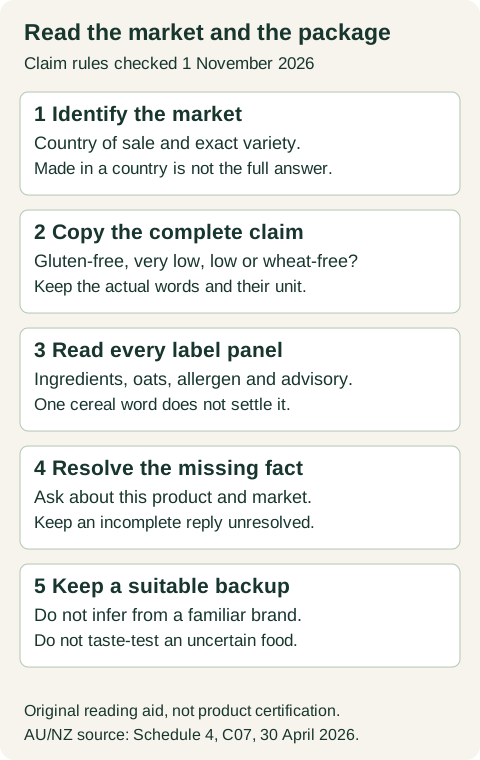
Use a five-step route at the shelf
First, identify the market and exact item. Second, copy the complete claim. Third, read the full ingredients and actual allergen/advisory statements. Fourth, resolve a contradictory or incomplete statement using current product-specific information. Fifth, keep a suitable backup if the missing fact cannot be established. This is an original reading sequence, not an official certification process.
A translation tool can help you notice unfamiliar words, but a cropped image or single translated cereal name cannot establish the whole claim. Preserve the original wording alongside a translation. Where the translation, importer sticker and package appear inconsistent, ask for reliable clarification for that exact market version.
Read a certification mark separately from the manufacturer’s words. FDA does not require, endorse or accredit a particular third-party gluten-free program. A mark’s absence does not itself prove gluten is present, and a familiar symbol is not proof of every product that brand sells. If a specific program matters to your own plan, confirm the current program and variety.
Advisory wording also needs context. FDA permits truthful wheat-facility advice alongside a compliant gluten-free claim, while Coeliac UK explains voluntary may-contain wording and contacting the manufacturer when unsure. Neither point creates one global instruction for every advisory statement. Keep the actual wording and any unanswered concern visible.
Keep a short market-and-package record
Use four concise entries rather than collecting unrelated screenshots. A useful note identifies what the current label says, which source applies, and what still needs an answer. Leave missing information marked “not recorded” or “unresolved”; do not fill a blank with a remembered brand reputation.
| Record field | Facts to copy | Question to resolve |
|---|---|---|
| Market and product | Country of sale, exact product/flavour/size, local importer and lot/package details. | Does the information describe the item in my hand and the rules for its sale? |
| Exact claim | Copy the full words, their language and panel location. Record any certification program separately. | Is this gluten-free, very low gluten, low gluten, wheat-free, or merely a related description? |
| Full ingredients and declarations | Read every ingredient and the actual allergen and advisory wording. | Is a grain, processed derivative, oat ingredient or contradictory statement unresolved? |
| Evidence and next question | Current regulator/source version, matching manufacturer reply, and the specific missing fact. | What is confirmed, what is still unknown, and which suitable backup will I use? |
For example, a draft question can read: “For [exact product, flavour, size and package/lot] sold in [market], does your current gluten-free information apply to this package? It states [claim] and lists [ingredient or advisory]. Please clarify [one specific inconsistency] and identify any difference from your other market versions.” This is a template for your own inquiry, not a message already sent.
A reply saying “we make gluten-free products” is not enough to identify the requested variety. A response about a different country or flavour leaves the original question open. Record that limitation instead of stretching a general answer into a confirmation.
Download two blank package records, the comparison and all eight worked cases. For a redesign of an otherwise familiar package, use the packaging-change recheck instead; it compares old and new panels rather than mapping legal regimes.
Practise with eight fictional market and label cases
These original simplified cases teach source and label reading. They do not describe tested brands, real laboratory reports or manufacturer replies. Decide what the stated facts support before opening each explanation.
Case 1
A fictional US FDA-regulated food lists intentionally added barley malt. A seller says its result is 12 ppm and therefore the gluten-free claim must comply. Is the number enough?
Show answer and explanation for case 1
No. The ingredient restriction still applies.
FDA does not allow barley malt in a food bearing a gluten-free claim merely because a finished-food result is below 20 ppm. Save the exact claim and ingredient wording and resolve the contradiction for that product. The concentration is one part of the rule; it does not override a prohibited ingredient.
Case 2
A fictional EU food contains qualifying specially processed cereal ingredients and is described as 60 mg/kg gluten. Does that number support calling it gluten-free?
Show answer and explanation for case 2
No. It exceeds the 20 mg/kg gluten-free limit.
The 100 mg/kg very-low-gluten category has different conditions, including the qualifying specially processed ingredients. The stated facts illustrate why the two claims are separate. They do not assess the food for an individual diet or verify a real manufacturer’s compliance.
Case 3
A fictional result is exactly 20 mg/kg. May you say that the US and EU concentration wording is identical at that boundary?
Show answer and explanation for case 3
No. FDA says less than 20 ppm; the EU Annex says no more than 20 mg/kg.
For concentration by mass, ppm and mg/kg describe the same unit. The boundary words differ. This is a reading exercise, not an instruction to approve a food from one laboratory number; sampling, measurement, ingredients and the rest of the applicable requirements still need their own evidence.
Case 4
A fictional Australian label says low gluten. Someone equates its 20 mg/100 g limit with the EU 20 mg/kg gluten-free limit. What needs correcting?
Show answer and explanation for case 4
The units and the claim: 20 mg/100 g equals 200 mg/kg.
One kilogram contains ten lots of 100 g, so the first concentration is ten times 20 mg/kg. Schedule 4 uses this number for low gluten, while its gluten-free conditions require no detectable gluten and exclude specified ingredients. Neither claim should be silently renamed as the other.
Case 5
An oat snack bought in the US carries a gluten-free claim. Does that prove an identical claim is permitted when that oat-containing food is sold under the Australian/New Zealand Code?
Show answer and explanation for case 5
No. The claim rules for oats differ.
FDA allows oats to carry the claim when its requirements are met; the reviewed Australia/New Zealand gluten-free claim excludes oats and oat products. Match the applicable market version rather than treating a foreign claim as universal. Whether oats fit a person’s dietary plan is a separate clinical question.
Case 6
A fictional EU food carries a gluten-free claim and lists specially processed wheat starch. Does the word wheat alone prove the claim is contradictory or that the food is wheat-free?
Show answer and explanation for case 6
Neither conclusion follows from that word alone.
The gluten claim concerns the applicable gluten requirements; a wheat-related ingredient and allergen question needs its own reading. The claim does not mean wheat-free or assess a wheat allergy. Read the current complete label and resolve product-specific uncertainty instead of using either a wheat-only rejection rule or an allergy assurance.
Case 7
A package sold in Northern Ireland says made in Great Britain. Is that phrase enough to identify the labelling regime that applies to this product?
Show answer and explanation for case 7
No. Identify the applicable supply arrangements and market information.
FSA describes special arrangements for specified prepacked retail goods moved from GB through the Northern Ireland Retail Movement Scheme. A country-of-manufacture phrase does not demonstrate that a particular item used that scheme. Ask the importer or manufacturer for the missing product-specific context instead of inferring it.
Case 8
A translation app finds no word for wheat in a cropped ingredient photo, while the actual package’s other panels are unread. Has the whole gluten question been checked?
Show answer and explanation for case 8
No. The current label and broader ingredient question remain incomplete.
Wheat is not the only relevant cereal, the image may omit the claim or other ingredients, and translation can miss context. Read all actual panels and obtain reliable local or manufacturer clarification where needed. An incomplete photograph, shelf position or a lack of immediate symptoms is not a verification method.
Check source versions and handling after purchase
The US Q&A used here was last marked current on 30 June 2022 and was checked on 1 November 2026. The EUR-Lex page showed Regulation 828/2014 in force; its complete English Annex and the UK-published Annex were read separately. FSA guidance was updated 17 July 2026. A check date records when these sources were consulted; it does not mean every regulator revised its rules that day.
The Australia/New Zealand comparison uses the authoritative Schedule 4 register text. The register showed compilation F2026C00415, C07, dated 30 April 2026 as its latest version when checked on 1 November 2026. The complete gluten-free and low-gluten rows, their column headings and the relevant introductory context were read. Other nutrition and health claim tables are outside this guide’s scope.
FSANZ says its combined Code PDF is a reference compilation and points to the Federal Register as authoritative. Use FSANZ’s official legislation directory and the latest Schedule 4 register entry to check subsequent amendments. A source check date is not a guarantee against future changes.
A packaged-food claim does not answer what happens after opening. Shared crumbs, utensils, added sauces or a restaurant’s earlier marinade introduce separate questions. Use the shared-fryer questions or shared-condiment procedure for those tasks.
If a food is associated with illness or the choice depends on your medical condition, obtain appropriate healthcare advice and preserve the package for the relevant follow-up. Eating a small amount, waiting for symptoms or finding no immediate reaction is not a way to verify the label. The purpose of this guide is a clearer reading and a focused next question.
Sources and further reading
- FDA: Questions and Answers on Gluten-Free Food LabellingFDA scope, imported foods, ingredient conditions plus less-than-20-ppm limit, oat claims, voluntary claims, certification and advisory wording.
- EUR-Lex: Regulation (EU) 828/2014In-force document and Annex A/B: gluten-free, very low gluten, specially processed ingredients and additional conditions for oats.
- UK legislation: Regulation 828/2014 AnnexLatest available UK-published Annex and its stated amendment history; distinguish the UK publication from the current EU record.
- FSA: Allergen Guidance for Food BusinessesGuidance updated 17 July 2026: emphasised ingredients, GB assimilated-law context, NIRMS qualification and the separate handling question.
- Australia/New Zealand: Official Schedule 4, Compilation C07Authoritative register version F2026C00415 C07, 30 April 2026, shown as latest on 1 November 2026. S4—3 column headings and complete gluten-free/low-gluten claim rows; not a review of every nutrition or health claim.
- Coeliac UK: How to Read Food LabelsNamed-cereal ingredient emphasis, specific processed-ingredient exemptions, current-package and voluntary advisory wording context.