Practical guide
Serving Gluten-Free Food at a Buffet: Keep Spoons and Portions Separate
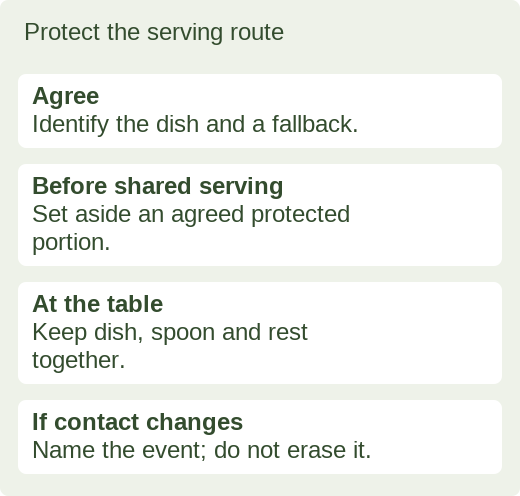
Confirm the dish and preparation with the guest before the event. Protect an agreed portion before shared serving, give each dish its own clean utensil and suitable rest, and keep bread or other food contact out of that route. A “gluten-free” sign helps people choose a dish; it does not prevent a spoon from being moved.
On this page
Agree the food before arranging the table
Ask the guest what arrangements they need and whether the proposed dish, ingredients and preparation can meet them. Keep the actual ingredient information available for the food you are offering. An attractive table arrangement cannot confirm an unknown sauce, coating or seasoning.
NIDDK advises people with celiac disease to tell a social-gathering host, find out whether gluten-free food will be available and bring suitable food if the arrangements are unavailable or uncertain. Decide that fallback before the buffet opens so the guest does not have to make a rushed choice from a vague reassurance.
This guide applies the documented preparation-and-serving contact principle to an ordinary shared table. It is a host planning method, not an inspection or certification of a venue.
Sources: [1].
Make an earlier portion genuinely separate
Before open serving starts, set aside the agreed portion using clean utensils and a suitable clean container. Keep that portion separate from the shared table and protect it from later food or utensil contact. Ask how the guest wants to receive it; do not hide it in a place only one host knows.
“Protected portion” describes its handling history and arrangement. It does not fix an earlier ingredient or preparation problem. Use food already confirmed for the intended meal, and follow the actual dish’s storage and food-hygiene instructions.
Keep any reserve food separate as well. If a buffet dish has had uncertain contact, topping it up from the reserve mixes handling histories. Serve a fresh agreed portion with clean tools instead of using reserve food to make the old shared dish appear reset.
Sources: [1].
Give each dish a spoon, a rest and a clear route
On a phone, scroll within the table. Keyboard users can focus it and use arrow keys.
| Part of the route | Arrangement to explain | Problem to catch |
|---|---|---|
| Dish | Keep the identified food separate from bread, toppings and other dishes. | A topping or food added after the ingredient check. |
| Serving utensil | One appropriate clean spoon or tong set stays with its dish. | A tool is borrowed from another dish or returns after touching food on a guest’s plate. |
| Utensil rest | Provide a suitable clean place for the tool. | The food-contact end lands on bread crumbs or another food. |
| Earlier portion | Keep the agreed portion separate before open serving. | It is returned to the buffet or served using a tool of uncertain history. |
- Confirm the food and preparation, then label the identified dish in words guests can understand.
- Choose a table arrangement that keeps bread and other food contact away from the intended dish and its utensils.
- Put the appropriate clean serving tool and clean rest with that dish before people begin serving.
- Explain the one-dish utensil rule to the people helping serve; identify who will notice a tool being moved.
- Keep the agreed earlier portion and reserve food separate from the open-serving route.
- If contact changes, stop and name it before offering that dish as the agreed gluten-free food.
There is no universally safe centimetre distance between buffet dishes in the cited material. The useful question is whether the real serving movements keep food, plate contact and utensils separate. A sign and an extra gap cannot substitute for that arrangement.
If a serving spoon is switched, separate the tool from the food event
A spoon touches bread and is caught before it reaches the intended dish: remove it from that route and replace it with a suitable clean tool. Check that its food-contact end did not already touch the dish, its food or the rest.
A spoon touches another food and then enters the intended dish: record that event. A clean replacement only changes the next serving operation; it does not remove contact that already happened in the food. Do not quietly swap the spoon and continue presenting the dish as verified.
If nobody can establish the utensil’s recent use, leave that uncertainty visible. Offer the earlier agreed portion if its ingredients and handling remain known, or another alternative the guest can verify. Do not ask them to prove suitability by tasting it or waiting for an immediate reaction.
Sources: [1].
Work through three serving decisions
These are fictional teaching situations, not observations of a real buffet.
Case 1
A host labels the pasta salad gluten-free. A guest uses its spoon to move bread, then returns the spoon to the salad. Does a fresh spoon restore the earlier food description?
Show answer and explanation for case 1
No. Name the contact event and use an agreed alternative whose ingredients and handling remain known.
The sign describes the intended food; it cannot control utensil movement. A clean replacement stops a future transfer but does not erase contact already involving the salad.
Case 2
An earlier portion was set aside with clean tools, but its container is later emptied into the shared buffet dish. Is it still the separate fallback?
Show answer and explanation for case 2
No. It has joined the shared serving route.
A fallback needs its own continuing handling arrangement. Its history cannot remain “kept separate” after it is returned to the open dish.
Case 3
A host protects the serving tools but does not know which dressing was used. Can the guest rely on the utensil plan alone?
Show answer and explanation for case 3
No. Identify the dressing and complete preparation or agree on another known option.
Ingredient confirmation and later serving contact are two different jobs. A well-arranged spoon does not supply missing ingredient information.
Use a short host handover
Try: “This is the dish we discussed, and its ingredient information is here. This spoon stays with it and rests here. The portion set aside before shared serving is in this identified container. Please tell me if a spoon moves or touches another food.”
A guest can ask: “Was this portion taken before shared serving? Which tool has been used on it? Has anything been added since we checked the ingredients?” Answer with what actually happened, and say when something is unknown. Clear information lets the person choose the agreed meal arrangement without a promise the host cannot substantiate.
Sources and further reading
- NIDDK: Eating, Diet, & Nutrition for Celiac DiseaseCross-contact can occur during preparation and serving; store/prepare gluten-free foods separately, ask about complete preparation and agree social-gathering arrangements. Page last reviewed October 2020, checked November 11, 2026.
- Coeliac UK: Cooking at HomeCurrent washable-item detergent/dishwasher guidance, clean oil and condiment handling. The whole cooking/serving routes below are original applications, not tested cleaning or food results.
- Coeliac UK: Cross-ContaminationHome cross-contact guidance on cleaning, clean frying oil, condiments, boards and toasters. Checked November 11, 2026.