Clean Utensils for Gluten-Free Cooking: Wash, Dry and Store
Washable utensils need thorough detergent cleaning and protection from new contact. Follow the item’s instructions, remove residue from shared cleaning materials, and keep drying, storage and serving on the clean side of the workflow.
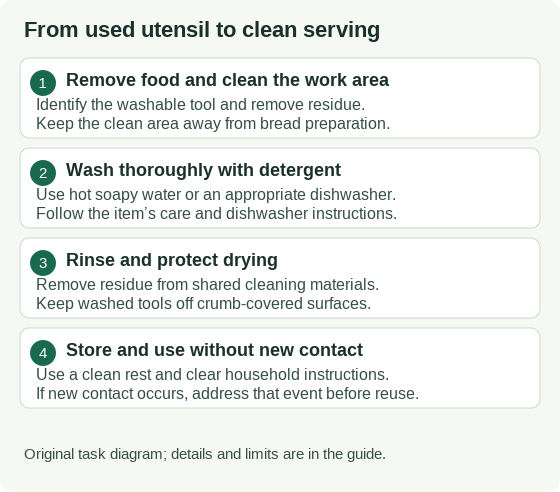
A washable-utensil routine starts with cleaning, not a sticker
For washable cutlery, pots, pans and cooking utensils, remove food residue, wash thoroughly with appropriate detergent, rinse and protect the cleaned item from new contact. A gluten-free label on a spoon or a separate storage box helps people find it; it does not remove food already on it.
Coeliac UK’s current cooking-at-home guidance says to clean surfaces, pots, pans, cutlery and cooking utensils with hot soapy water. It says washing-up liquid removes gluten, or a dishwasher can be used with suitable dishwasher detergent. This is useful practical cleaning advice, not a demand that every household buy a separate set of every washable item.
This guide turns that advice into a daily workflow for washable items. It does not establish a universal cleaning method for porous boards, a toaster or every complex appliance, and it does not measure gluten remaining on a particular utensil. Use the item’s own cleaning instructions and choose an appropriate clean alternative if you cannot remove residue or establish a workable setup.
Make space for the clean items before washing them
Identify the items needed for the next preparation: the knife, spoon, pan, draining tool or serving container. Remove leftover food and visible residue as part of cleaning. A brief rinse of a used utensil is not the same workflow as thorough washing with detergent.
Prepare a clean work area and somewhere suitable to place the washed items. A clean utensil put down on a board covered in bread crumbs can acquire new contact after washing. Think about the counter, utensil rest, drying area and storage as part of the same route.
Keep raw-food handling and ordinary kitchen hygiene in view. Gluten control does not replace cleaning for other food hazards or override the utensil and dishwasher instructions. Follow the care instructions for the item and the cleaning method you use.
If two people prepare different foods at the same counter, agree on the sequence and area before the clean utensils appear. A visible clean space and a clear handover are more useful than asking someone to guess which tool may have touched bread.
Wash the item thoroughly using a method suitable for it
- Remove the food residue. Check the working surface, handle junction and other accessible areas. A label on the handle does not describe the food-contact end.
- Wash with detergent. Coeliac UK recommends hot soapy water for washable kitchen items, or suitable dishwasher detergent in a dishwasher. Follow the item’s care instructions and the machine instructions rather than inventing a fixed soak time or temperature.
- Check accessible crevices and contact surfaces. Where residue remains or a tool cannot be cleaned appropriately, do not call it ready merely because the visible flat surface looks better. Use a suitable clean alternative and resolve the cleaning question.
- Rinse and complete the cleaning process. Keep food residue from cleaning materials and shared surfaces from returning to the item.
- Protect the clean item. Place it in a clean drying or storage area and keep it away from the next bread-preparation step.
Gluten is a protein, not an organism you can kill with a sanitiser claim. A statement that something was disinfected or heated is not a description of detergent cleaning and removal of food residue. Washing and appropriate food hygiene need their own steps.
The task is to make this washable item ready for its intended use, then prevent a new contact event. It is not to recover gluten-free food after a gluten-containing ingredient has already been mixed into it. Cleaning a spoon does not remove that earlier ingredient from a meal.
Shared sponges and cloths need residue control
Coeliac UK says you do not need separate cloths or sponges, provided residue is rinsed away. The practical instruction is to keep the cleaning material from carrying food residue back onto the items being cleaned, rather than making a blanket rule that every sponge must be newly purchased or permanently dedicated.
Check the actual condition of the sponge, brush or cloth before using it on the utensils you are protecting. If it carries crumbs or food residue, clean it appropriately or use a suitable clean alternative. A separate colour or kitchen label does not establish that the material itself is clean.
Keep the drying route clean as well. Use a clean drying area or clean towel appropriate for the item, and do not wipe the washed surface with a cloth that has just collected bread crumbs. These are original workflow applications of residue removal and avoiding recontamination, not a laboratory validation of every cleaning material.
A household may choose separate materials because that is easier to manage. That can be a practical arrangement, but it should not be presented as an unavoidable rule from the cited Coeliac UK guidance. The cleaning and later contact still need attention.
Keep drying, storage and use on the clean side
| Stage | Practical arrangement | Contact to catch |
|---|---|---|
| Drying | A clean place or suitable clean towel for washed items. | A cloth or surface carrying food residue. |
| Storage | Clean drawer, container or protected area where the item can be identified. | Used tools mixed back into the clean supply. |
| Preparing | A clean utensil rest and appropriate clean work surface. | Putting a clean knife onto a bread board or crumb-covered counter. |
| Serving | Use the cleaned utensil for the agreed serving task. | A spoon returning from another plate or food to protected stock. |
| Handover | A clear note about which items are clean and ready. | A label being read as proof of cleaning after unknown use. |
A small “clean and ready” area can make the arrangement visible. Explain what the label means: the items have been cleaned and are being protected for this preparation. It is a household cue, not a manufacturer certification or gluten test result.
If a tool touches gluten-containing food or a crumb-covered surface again, address that new event before using it for the protected preparation. For a washable utensil, that may mean cleaning it again with the appropriate process or choosing another clean item. Do not silently return it to the clean area.
Keep serving utensils and stock food separate from bread-contact tools. The shared-condiment guide has the separate one-way portioning routine. It explains why cleaning a new spoon does not reset a jar that already received a used bread knife.
Some tasks need a more specific equipment or food question
A washable spoon and a toaster are different cleaning tasks. Do not extend this simple detergent routine to every appliance, porous surface or inaccessible part without the relevant instructions and an arrangement you can actually follow. If residue cannot be removed or a process cannot be established, use a suitable clean alternative.
A colander or another draining tool needs attention to the working surface and accessible openings, not just a clean-looking handle. The Celiac Disease Foundation identifies colanders, boards and shared containers as possible cross-contact points. That supports checking the actual tool; it is not proof that every material always requires replacement.
Cooking oil is also a separate issue. A washed basket does not change oil that has been used for gluten-containing breaded food. Use the shared-oil question guide, rather than treating clean utensils as an answer to the fryer.
Likewise, clean tools cannot settle an unknown sauce or ingredient. Check the actual food and full recipe as well as its handling. For a restaurant meal, use the whole-order card; this home workflow does not inspect a restaurant kitchen.
Give the next person a specific instruction
Use a clear handover such as: “These utensils were washed and are in this clean area for the next preparation. Put them on the clean rest. If one touches bread or an unclean surface, keep it out of this area until it is cleaned again.” That tells a guest what to do, rather than asking them to interpret an unexplained colour code.
After a mistake, record the actual event: “clean spoon placed on the bread board; removed from the ready area; appropriate cleaning needed.” If you do not know what happened, say what remains unknown. A quiet assumption that everything looks fine does not help the next person.
The record below follows the tool, cleaning material, drying area and later use. It is a memory aid, not a scored test that certifies a kitchen. If a food is associated with symptoms or suspected exposure, seek appropriate healthcare advice; do not use this worksheet, a taste or absence of an immediate reaction to assess personal medical safety.
Keep the facts and the next question
Download the plain-text record, or copy the fields below. Leave missing information marked unknown.
WASHABLE-UTENSIL PREPARATION RECORD
Item and intended task:
Care instructions and suitable cleaning method:
Food residue removed from accessible surfaces:
Detergent washing or appropriate dishwasher completed:
Rinsing completed:
Cleaning material free of relevant food residue:
Clean drying area or suitable clean towel:
Clean storage or ready area:
Clean rest and preparation surface:
Household/guest instruction explained:
Any new contact after washing:
Action before reuse:
Ingredient or recipe question still separate:
Equipment task needing specific instructions:
This is a workflow record, not cleaning validation or a gluten measurement.
Try these reading checks
These are original fictional situations for practising the distinctions in this guide.
A fictional knife is washed thoroughly, then placed on a crumb-covered bread board. Does the washing step settle its later use?
No. A new contact event happened after washing. Keep the knife out of the ready area until it is cleaned appropriately again, or use another suitable clean utensil.
A household shares a sponge. Does the cited Coeliac UK guidance require a new dedicated sponge for every preparation?
No. It says separate cloths or sponges are not required if residue is rinsed away. Check and control the actual residue rather than inferring cleanliness from whether the sponge is shared or labelled.
A used spoon gets a gluten-free kitchen sticker without being washed. Is it clean and ready?
No. The sticker is a cue, not a cleaning process. Remove food residue and wash, rinse and protect the washable utensil using an appropriate method before relying on it.
All utensils are clean, but a recipe contains an unidentified cooking sauce. Is the food question resolved?
No. Ingredient suitability and utensil handling are different questions. Identify the sauce and whole recipe; cleaning tools cannot remove an earlier gluten-containing ingredient or confirm an unknown one.
Sources and scope
Coeliac UK supplies the current washable-item detergent and dishwasher advice and says separate cloths or sponges are unnecessary if residue is rinsed away. The Celiac Disease Foundation identifies shared utensils, colanders, boards, containers and double-dipped condiments as cross-contact points. Drying, storage and handover examples apply those principles; they do not validate a particular tool, porous material or appliance. No temperature, contact time or gluten measurement is invented.
Sources checked 2026-11-03. A check date records when the listed information was read; it does not mean the source or rules changed on that date. The examples, diagram and record are original teaching material.